Not everything has to become content, currency, or even polished craft. Some things can just be ours.
Too often, when friends tell me about their hobbies, it comes with a disclaimer: “I’m bad at it,” “It won’t make me rich,” “I’m embarrassed to show anyone.” I nod—empathetically, of course—because we’ve all been there. We’ve all heard that little voice in our heads saying, Cool, you’re doing this thing, but what will come of it? If you’re not exceptional at it, why bother? But maybe it’s worth asking why these things matter in the first place. When did fun become a product? I think it’s time to bring back the pure joy of doing something with no strings attached.
READ ALSO: Astrology’s Power Lies In Labels, Not The Stars
How Late Capitalism Kills Hobbies
You’ve heard it plenty of times before, but we can’t deny the effect of late capitalism and its impact on our collective mindset. As Merriam-Webster defines it, the term “is characterized by a globalized, post-industrial economy, where everything—not just material resources and products but also immaterial dimensions, such as the arts and lifestyle activities—becomes commodified and consumable.”
To put it simply, people are reduced to “consumers,” and all endeavors are framed as “content” or “product” with profit potential. This isn’t to say you shouldn’t turn your passions into ventures that help you live a comfortable, financially secure life; in the flawed system we’re in—especially when many Filipinos lack the socioeconomic mobility to chase their dreams without worrying about the next meal or the bills to pay—that’s a blessing.
But we’re not talking about survival, we’re talking about the in-between: the things we fill our spare time with, the ways we try to infuse enrichment into our lives beyond capital. The urge to turn everything we do into a product is so deeply ingrained in our consciousness that we can’t seem to hit the figurative brakes. And so we find ourselves in a state of constant acceleration, careening down a highway, thinking about the next route rather than looking at the scenery—cliché, but you know it’s true.
Still, we can’t be naive. To act or engage in “pointless pursuits” is a privilege in our current climate; but the thing is, it shouldn’t be one in the first place. Joy should be free, and it’s a fundamental human right to pursue it without any expectations weighing us down.
With our eyes fixed on output, we’ve forgotten the art of process and all the beautiful imperfections that come with it. So when my friends show me the things they make, or talk about the small “unproductive” activities they love doing, I hold them close to my heart like something precious: here are people who, despite everything life throws at them, choose to carve out a safe space for themselves, failures and all—a quiet act of rebellion in a world that expects us to sell everything we hold dear, leaving little for ourselves.
But beyond the systems that commodify us, there’s another enemy we’ve internalized, one that lives in our heads: the fear of being seen trying.
Fear Of Cringe: Why We Sabotage Our Own Pursuit Of Joy
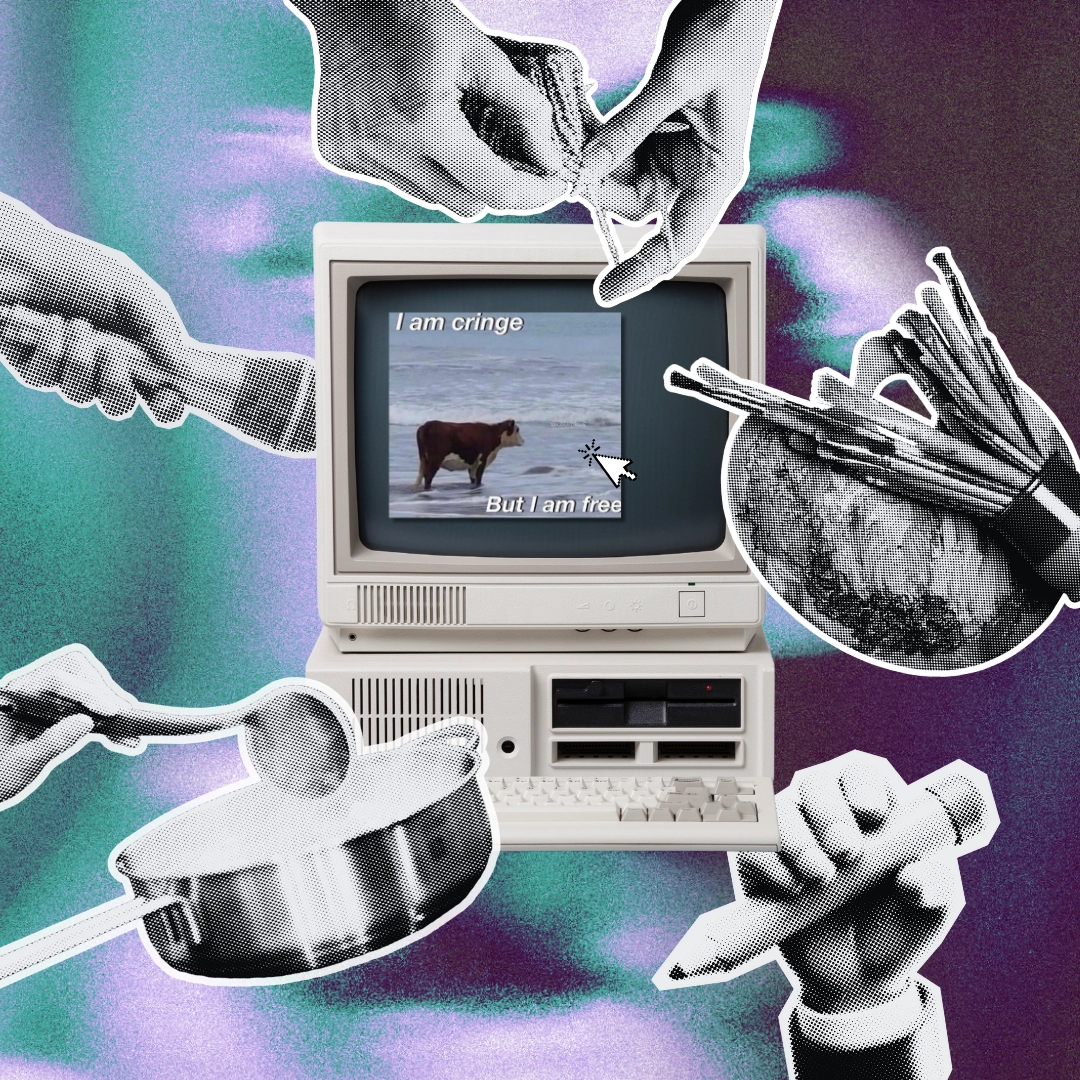
“Cringe cultureCultureshared traditions, beliefs, values, customs, arts, and social practices that define the identity and way of life of a community, society, or nation.Go to Culture Glossary” also plays a role in the ways we approach our hobbies. The acclaimed Vietnamese-American writer Ocean Vuong, who teaches Creative Writing at New York University, expressed his concern when observing the behavior of his students.
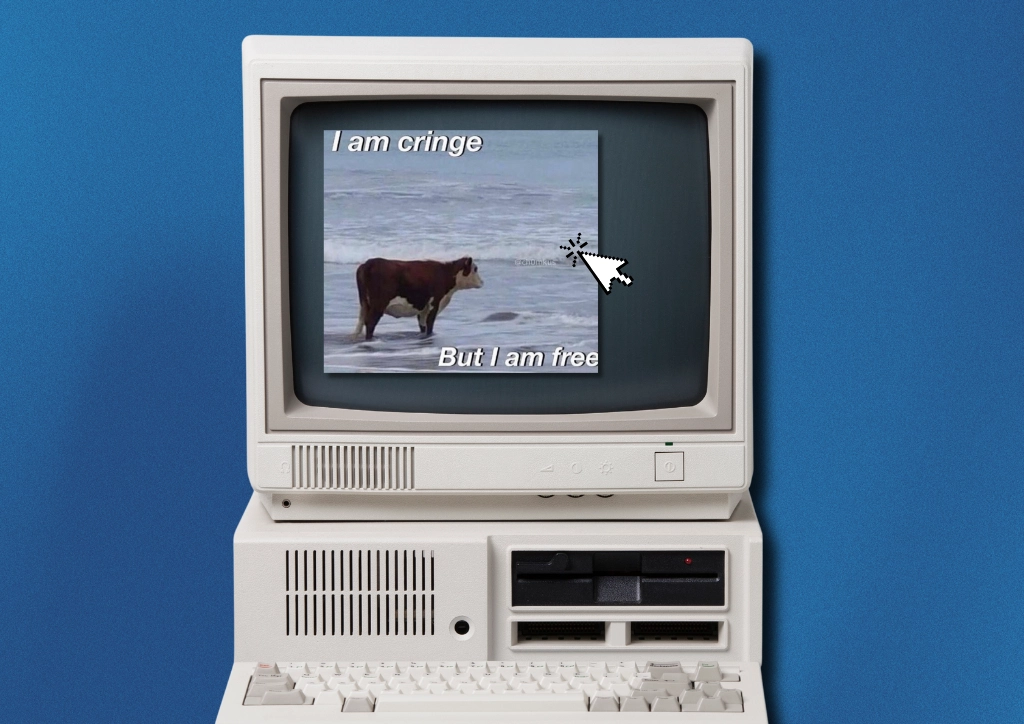
“What I’ve noticed, in a very unsettling way, is that our students, at least in America, I can’t speak for other places, they are more and more self-conscious of trying,” he shares in an interview with ABC News. “There is a kind of surveillance cultureCultureshared traditions, beliefs, values, customs, arts, and social practices that define the identity and way of life of a community, society, or nation.Go to Culture Glossary around social media, and they would say, ‘I want to be a poet, I want to be a good writer, but it’s a bit cringe, right?’ This cringe culture is, ‘I don’t want to be perceived as trying and having an effortful attempt at my dreams.’ And as a teacher, that’s a horrifying […] report from the field. I think they’re absolutely scared of judgment. […] And so they pull back. But in fact, they are deeply hungry for sincere, earnest effort.”
While Vuong’s insights refer to those honing their craft, it applies to almost any endeavor—even the ones we’re supposed to be doing simply for our sake, and no one else’s. We can, of course, tie this all to the state of neurotic perfectionism that is the online age, with its constant demand for visibility (picture or it didn’t happen) and performance (if it’s ugly, don’t post it).

In her essay “The Pain of Perfectionism,” writer Leslie Jamison speaks with psychology professor Gordon Flett, who spent years studying the state of perfectionism. As Jamison writes, Flett believes that “young people, especially Gen Z-ers, are facing an ‘epidemic of perfectionism’” and it’s a crisis “largely fuelled by social media: people are tortured by the gap between their actual and their ‘perfected’ lives, not to mention the perfected versions of other people that circulate online.”
“Digital life compels us to make our lives into perfected artifacts,” Jamison adds, “Achieving perfection is the most efficient way to discover how little it offers.” The accomplishment of “getting it done right” has become the prerequisite for pleasure. Anything that falls below the benchmark of “post-worthy” has become, if not secondary, effectively useless. But in creating these mental blockades, what we’re really doing is sabotaging our own happiness.
The truth is, if we hinge the entirety of our life’s “value” (as if it’s quantifiable) and meaning on accomplishment, we may never be satiated with the act of living in the now. “So often, the plot of our lives seems like a clarion call for the extraordinary. It is, nearly always, how the world is marketed to us as consumers,” writes Devin Kelly in his essay “Out There: On Not Finishing.”
“I had to win at all costs. And yet: when was the last time anyone ever told a man to be ordinary? Think of the difference that would make, to begin to dismantle our need to be heroes, to finish things, to consider ourselves defined by accomplishment,” Kelly continues. “It takes a certain kind of grace to give yourself permission to do this, a certain kind of grace to say to yourself I’ve done enough, and sit down for a second, a minute, a day, a long time. Love does not always have to come after. It can be right here.”
Bad At Your Hobbies? Do Them Anyway
So where do we go from “here”? Want to get into portraiture, but struggle to even draw a perfect circle? Do it anyway. Interested in knitting or crocheting hats that look ridiculous? Go for it. Tone deaf but still want to get into singing? Dive right into it. The internet has made self-learning virtually free. Instructional books and YouTube videos exist.
If you’re not planning to become an expert, that’s fine. At the end of the day, what matters is this: are you having fun, and does it make you feel good?
Joy doesn’t need an audience or a purpose to exist. In the same way, you wouldn’t walk up to someone and ask how their happiness contributes to the GDP of their country. The most tenderly radical thing we can do is allow ourselves to play and make mistakes—not for mastery or money, but for the simple, stubborn pleasure of being alive enough to try.