Performers of Les Misérables: The World Tour Spectacular on the moral and emotional worlds of their characters.
Les Misérables is a musical that requires little introduction. Adapted from Victor Hugo’s behemoth novel, Claude-Michel Schönberg and Alain Boublil’s moving work has held a revered place in the musical theater canon since premiering in its original French in 1980, before crossing over to the now-iconic English production in 1985. Since then, the musical has inspired countless adaptations and pop cultureCultureshared traditions, beliefs, values, customs, arts, and social practices that define the identity and way of life of a community, society, or nation.Go to Culture Glossary references, alongside anniversary tributes and refreshed productions that continue to celebrate and reaffirm its legacy. The Les Misérables: The World Tour Spectacular in Manila is one such incarnation of the beloved piece.
Liberté, Égalité, Fraternité: Les Misérables Lives On
An expansion of the highly successful Les Misérables The Staged Concert—which ran for over 200 record-breaking performances in the West End—Les Misérables: The World Tour Spectacular brings together a star-studded cast; stunning new set and lighting designs; and an electrifying, concert-like production with a full orchestra front and center. If anything quantifiably signals the musical’s enduring appeal, it’s that all strictly limited performances have sold out since its run began this February, culminating on March 1, 2026.

Qualifiably, though? Les Misérables is a technical feat on many levels, but these aren’t the only reasons it lives on. Trite as this may sound (but no less true for it), the timelessness of its themes and characters is what has helped the musical remain beloved for so long. Though situated in a completely different era, its central thesis on the importance of freedom and its layered players, who refuse to settle neatly on a moral scale, are deeply relevant today.
There’s a little bit of Jean Valjean’s haunted soul in all of us, as well as fragments of Javert’s staunch dedication to his beliefs. Mothers see themselves in Fantine’s utter devotion; daughters forced to grow up too fast yet still clinging to innocence recognize themselves in Cosette; and in moments of selfishness, we may even catch shreds of the Thénardiers within us as well. In this Lifestyle Asia exclusive, we ask the cast of Les Misérables: The World Tour Spectacular to paint portraits of their characters, which in turn, reveal a little about themselves too.
READ ALSO: Backstage Musings: The Miss Saigon 2024 Cast Reflect On Their Roles And Professional Journeys
Author’s Note: Parts of these interviews have undergone minor editing for improved readability. Certain “Les Misérables” plot spoilers are touched upon; reader discretion is advised for those who haven’t seen the musical.
Gerónimo Rauch As Jean Valjean
Gerónimo Rauch’s booming voice echoes through The Theatre at Solaire’s backstage hallways, singing bits of song, jovial and open. He moves from room to room, greeting his co-stars with unhampered enthusiasm, eliciting laughter with humorous quips. You catch slivers of the man’s fatherly nature, yet he carries himself with a lightness that feels worlds apart from his emotionally encumbered character.
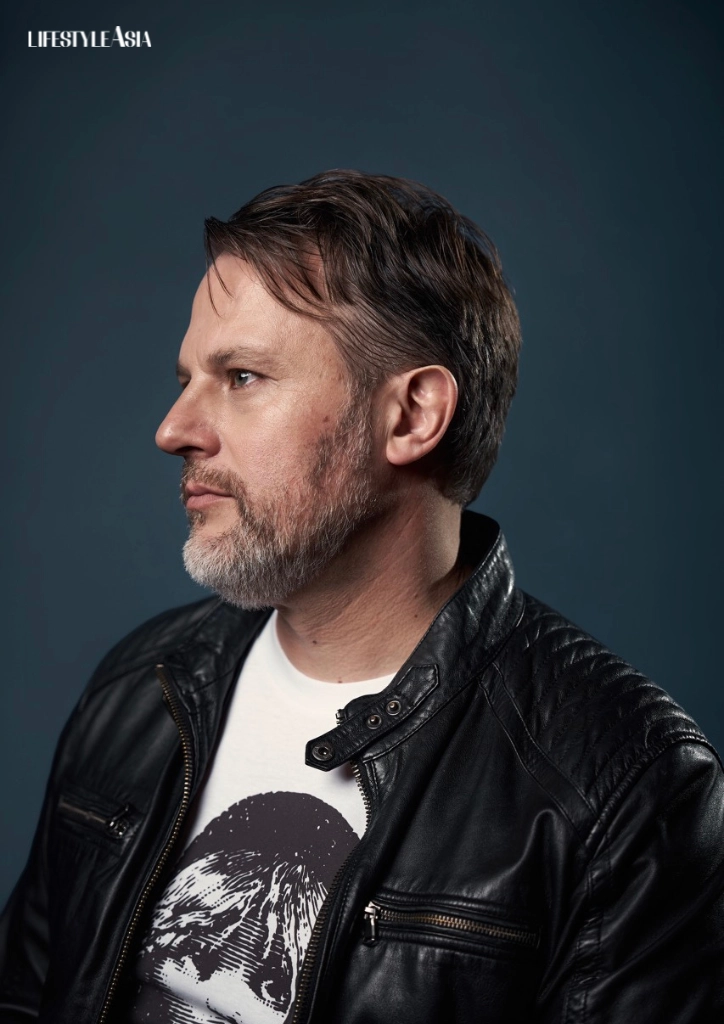
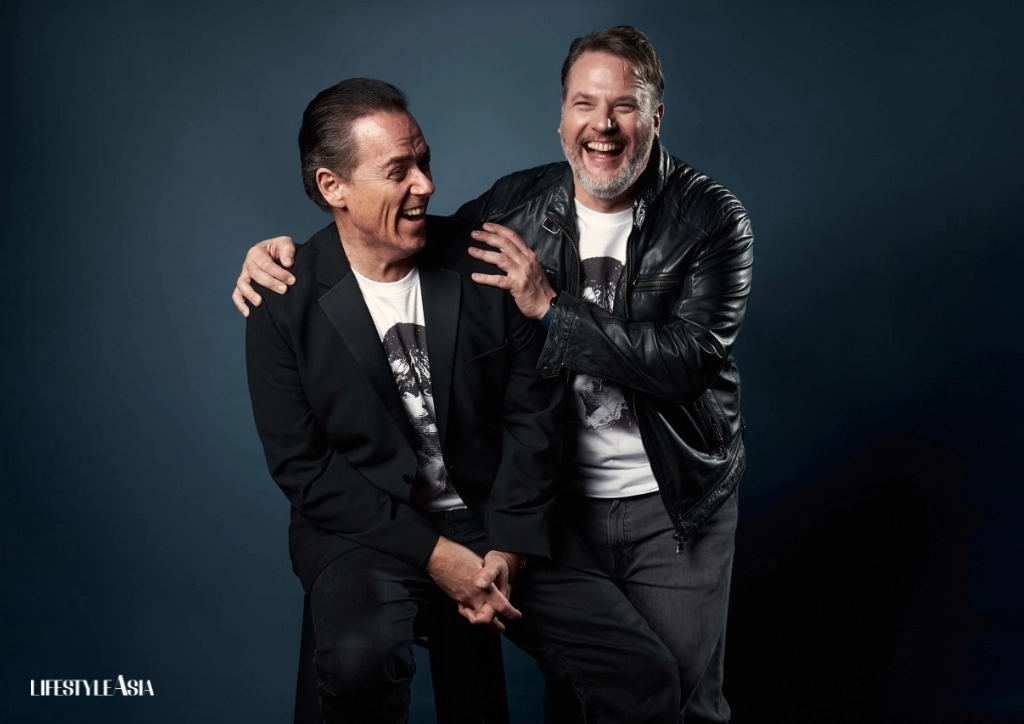
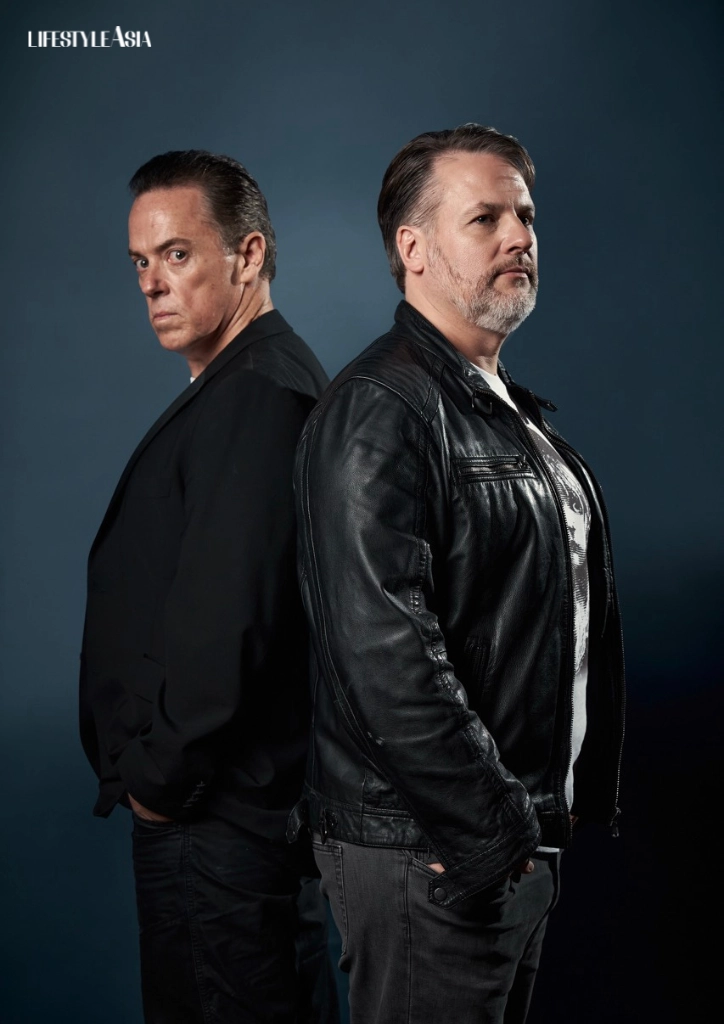
He’s joined by Jeremy Secomb (who plays Javert) in our interview. Offstage, the two men—who play foils to one another, locked in a relentless chase—sit calmly and chuckle together, their camaraderie evident in the way they genuinely listen to each other’s responses.
Is a life defined by the deeds themselves, or the intentions behind them?
Gerónimo: Intentions don’t change anything. You can have very good intentions, but if you don’t do anything, you will never make a change. But sometimes actions, like stealing a loaf of bread [laughs], can get you 19 years in prison. Jean Valjean has been trying to mend this in many ways in his life, and he’s been chased by his past constantly. He did good in his journey, he tried to do good. So there’s action there, and good intention as well. I believe we need more action in this world—that’s Gerónimo speaking.
What does it mean to truly start over?
Gerónimo: If you ever try to start over again, you need to give yourself the chance to start fresh. It’s a decision, you know, to erase part of your past. And erasing the past is very difficult.
For example, I moved to Spain in 2007 and I was very popular in Argentina. I had the chance to start fresh in Spain, and that was really nice. But I did feel that sort of starting again from scratch; or when I moved to London, I was new. When you make any change in your life, it’s sort of like starting fresh again.
Can redemption ever be completed, or is it a lifelong pursuit?
Gerónimo: If we speak about Valjean, he dies in the way that he never expected to die. It’s like a dream way of saying goodbye, with your loved ones. I believe that he got redemption in the end. He finally received it. But he dies thinking that Javert will still appear, because he doesn’t know Javert kills himself—he’s still being chased, so there’s not a full feeling of redemption. But he dies with a smile; it’s not a traumatic death.
Jeremy: Can I say something about this? I think that redemption comes from within as well. If you’ve done something, I think you have to forgive yourself, right?
Gerónimo: Yeah, it’s true.
Jeremy: You know, you look for redemption from other people, but you also have to give redemption to yourself. So I think, if you don’t forgive yourself for the things that you’re ashamed of or what you did to other people, it doesn’t mean anything.
Gerónimo: 100% agree on that.
Jeremy: Towards the end, for me, I think Valjean forgives himself on his deathbed. He’s seeing what he has done and not running anymore, because he knows he can’t run anymore. He knows it’s the end, and I think at that point, there’s true redemption.
Gerónimo: It’s a very Christian way of dying. Even before he dies, he already sees Fantine. He knows he’s leaving, he’s going to heaven. I play it [his role] in a very Christian way. I believe in Jesus, heaven, hell; every time I listen to Fantine’s first lines… [sighs contentedly]. Valjean is like, ‘Ah, yes, I’m leaving.’
Jeremy: That’s the point where he goes, ‘I’ve done okay here.’
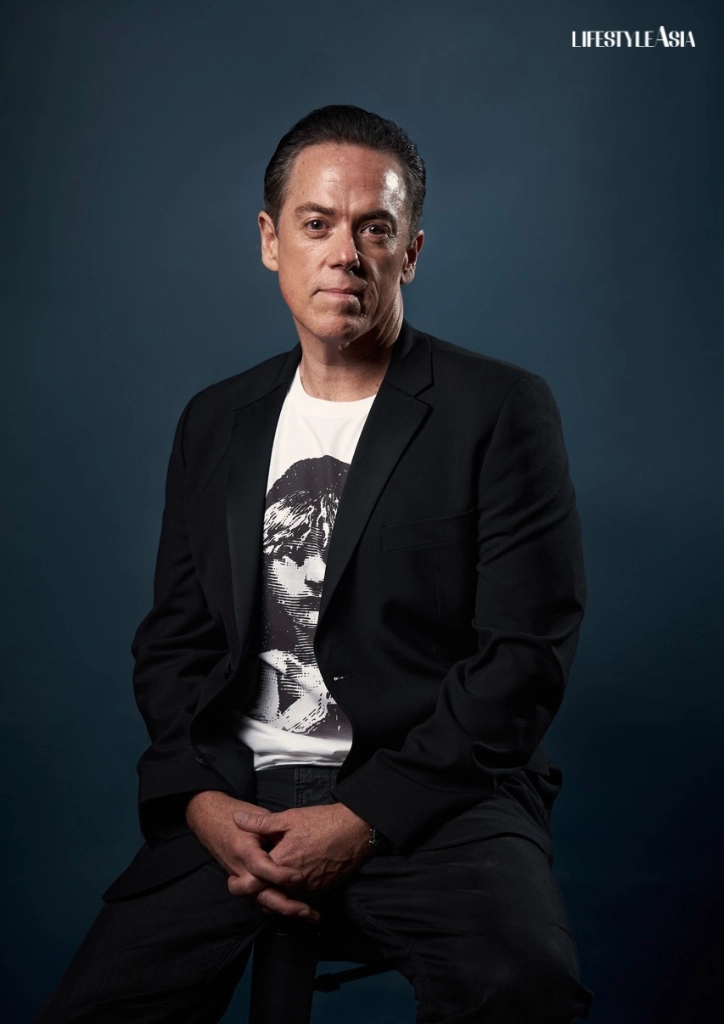
Jeremy Secomb As Javert
There’s a pensiveness to Jeremy Secomb, punctuated by flashes of a smile. When he listens to questions, you can tell he’s taking it all in, eyes sharp and focused, his attention unwavering. His answers are concise yet incisive, cutting straight to the heart of the matter—it’s easy to see why he can perfectly slip into a character as disciplined as Javert.
What does it mean to dedicate your life to a single ideal?
Jeremy: Two words sum it up for me: structure and control. For the character [Javert], they’ve allowed him to drag himself from where he came from in his early life [the prison guard and inspector was, ironically, born in a jail, to prisoner parents], to where he is now. He has that control because of the structure that he has in his life.
I believe he’s extremely religious, but it’s the old school religion: fire and brimstone, black and white. It’s all about the control he has because of those beliefs, and he holds onto that.
When does devotion to the law become blind?
Jeremy: When you can’t see past the structure. There are so many things in life, I think, that are gray areas. Personally, he doesn’t see gray. It’s black and white. When you don’t take into consideration everything that’s around what you’re enforcing, then it becomes blind.
What’s more frightening: disorder or doubt?
Jeremy: Doubt. Because you can’t control the doubt. Disorder can be controlled, eventually; you can get on top of disorder. Especially for the character, the biggest problem he has is when he doubts himself; that’s his downfall. It goes back to structure and control: all of a sudden, there is none, and he can’t see out. So I think that doubt is worse than disorder for him.
Personally, I doubt myself all the time. [laughs] I think it’s a human thing to doubt yourself; there’s good in that, to sort of step back and go, ‘Is this the right thing? Am I doing the right thing? Should I be doing something different?’ Questioning yourself constantly to further yourself. But I don’t think Javert thinks that way.
Rachelle Ann Go As Fantine
Rachelle Ann Go has embraced motherhood with a touching kind of happiness, her eyes glowing, sometimes misty, when she speaks about a mother’s capacity to love. She grins as she recounts anecdotes of her own children, and even when she acknowledges the challenges of parenthood, it’s clear she wouldn’t trade it for the world.

When survival is at stake, is sacrifice a choice or a necessity?
Rachelle: For Fantine, sacrifice becomes a necessity. You cannot waste time. You don’t sit down and weigh [in] the options. You have to act right away, especially as a mother and as a woman, I think the instinct always takes over. Survival isn’t about staying alive: it’s about fighting for your loved ones, fighting for the people you love most.
What’s motherhood?
Rachelle: I feel like I’m still learning what motherhood really means. Every single day, I’m discovering new things. It’s unconditional love. It’s probably the most humbling role I’ve ever known. It’s teaching me a lot. When I play Fantine, now that I’m a mom, I can relate to her every single night: the pain, the struggle. Every day you wake up, you have to show up. You have to protect your family, nurture them, guide them, [and] love them.
It teaches you patience, which I didn’t have before. I’m still working on it. Faith and strength, too. I can say so many things, it just feels just like quite a lot as well. There’s so much joy, yeah? Even when you’re so tired, you’re gonna do it. Once I see my family, my kids, sleeping at the end of the day, after doing eight shows a week…I’m fulfilled. I’m happy.
What does society owe its most vulnerable?
Rachelle: Nako, ang dami. [Gosh, so much.] Compassion, justice, grace, and a voice. With Fantine’s tragedy, the tragedies of other people, it’s not really their fault—there are so many things happening in their lives. Society needs to care for these people, genuinely care for them. There’s so much brokenness, so many desperate people out there who need help.
I was actually reading that last question yesterday, and I was like, ‘Whatever Fantine went through before, people are still going through it, and it’s probably worse right now.’ We just have to love each other. I think that’s the main thing, the purpose of life. I just want to hug everybody and make the world better.
Lulu-Mae Pears As Cosette
Lulu-Mae Pears almost always wears a soft, sweet smile, even in the most ordinary moments. She approaches every aspect of our shoot with earnestness, revealing a deeply felt heart. Even the smallest details seem to warrant care, her full presence evident in the way she instills a sense of ease within a space.

Is innocence something you naturally grow out of, or something you can fight to keep?
Lulu-Mae: I don’t think you necessarily grow out of it. I think if anything, it might fade because of experiences or things you’ve been exposed to in life; with Cosette, she does have a turbulent upbringing. I try to cling onto my innocence because it is a funny world out there. It can make you think that it isn’t as gentle or as lovely as you were once made to believe when you were a child. Sometimes, ignorance is bliss. Though in the grand scheme of things, innocence is something that might naturally fade due to experience.
What does safety feel like after fear?
Lulu-Mae: I suppose it’s quiet and calm—which can be quite discomforting, after fear. But the longer you sit in that quiet, the more peace you find. It’s warmth, it’s [the] love around you—just feeling comforted, being able to go to sleep and not having to think about footsteps because someone’s there to watch over you, make sure you’re safe.
Is love a form of liberation?
Lulu-Mae: I think so, if it’s the right kind of love. I don’t think any love should trap you from what you wish to become, or what you are already. In this situation with Cosette and [Jean] Valjean, I understand the protectiveness that Valjean takes on. There are moments where Cosette feels quite trapped: she just wants to explore and escape, but he’s protecting her because he knows what the world’s like. Parental love is also liberating, but in a different way, I would say.

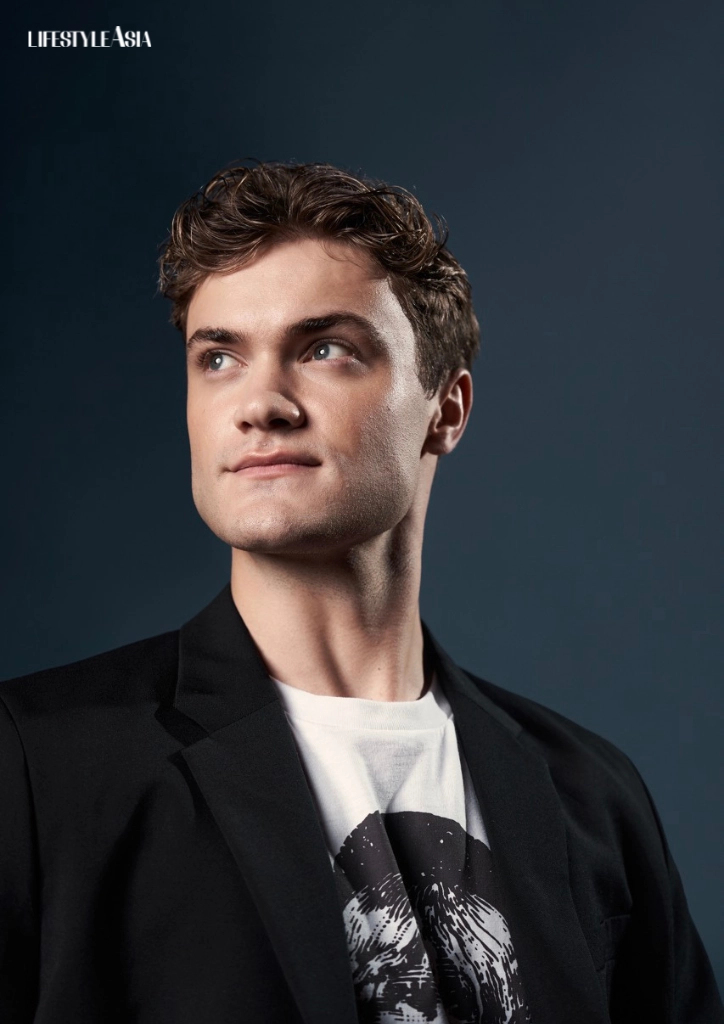
Will Callan As Marius Pontmercy
Will Callan is nothing short of accommodating as he sits next to his co-star Harry Chandler; the two men seem to get along as swimmingly as their characters, friends Marius and Enjolras. He sees the value in every question, says it makes him see his work a little differently. His youth mirrors that of his young revolutionary, idealistic and open-minded, but not naive.
Do you believe in love at first sight—two people knowing almost instantly that they’re meant for each other?
Will: At this point in my life, I’m quite young to be giving my opinion on that. I’ve definitely experienced the feeling in the past: coming across somebody in your life and instantly feeling like you want to give that person everything.
Marius certainly does believe that, because it’s very much one of the vehicles for the story of Les Misérables—without him bumping into Cosette, the entire trajectory of the show wouldn’t have gone where it needed to go for the plot. I think that his views changed so quickly just by meeting that one person; I don’t think he ever concerned himself with love before this. It’s very much his first experience with it.
Is it possible to balance personal desire with duty, or must one always take precedence?
Will: The position that Marius is in is a very delicate one, because he’s one of the younger students of the ABC [“Friends of the ABC,” the group of revolutionary students in Les Misérables], and we see him in the show being guided to a position he firmly believes he should be in. But I don’t think his views, other than the ones for Cosette, are his own, until he comes together with the other students to make a choice at the end of Act One, to pursue the revolution with Enjolras by his side.
When it comes to his personal duty, that’s something he recognizes throughout the show. It’s very much a balance he struggles to keep when reminding himself about Cosette, especially on the barricade—I don’t think she ever leaves his mind, but I think he’s very much aware of how important the greater good of Paris is in comparison to himself. He does make that choice for duty to come first before love.
What is more important, friendship or honor?
Will: This can be a very polarizing question, because I think it’s very dependent on your situation and the cause in which you find yourself in. With Marius, those two very much blend together. The friendship he has with his brothers in arms is the one that leads him to honor the cause he’s meant to be fighting for. For him, it’s quite a straightforward answer: he’s proving his friendship to his friends by standing alongside them.
I would say that people put their beliefs first, and they just tend to come together if they share the same beliefs. So yeah, honor comes first, and I think friendship is what’s built on it.
Harry Chandler As Enjolras
There’s a humility to Harry Chandler when he admits he doesn’t have all the answers to big questions, or the experience to speak on behalf of everyone. He has, thankfully, never had to bear the brunt of leading a revolution; still, he ponders on every question carefully before he answers, which in itself reveals a kind of wisdom for someone as young as he.

Is a revolution betrayed when it accepts partial justice instead of total change?
Harry: It really depends on the goals and aspirations of the people that are revolting, because partial justice can mean change, but in the parameters of what’s allowed. It’s not a total change, but I think it’s a compromise. In some ways, that’s very good, because that means something has been changed. But it also depends on how willing the opposing sides are to accept that change: it might go against someone’s ideals while being in favor of another’s ideals. So there does need to be that compromise. Personally, yes, it can be good.
In terms of Enjolras and the students, particularly Enjolras—because he’s so unwavering in his goals [of freedom]—it is betrayed. That’s why, unfortunately, when he realizes that it’s not going to happen, he sort of becomes a martyr. He thinks, ‘Maybe this will allow for total change in the future.’
What responsibility does a leader bear when asking others to die for an idea?
Harry: It’s the responsibility of human life. I’m never going to know how that feels—well, hopefully not. These people who have their own families, their own partners and friends, can potentially die. It’s a ripple effect, because all those people’s lives are affected as well. That’s a huge responsibility of life that someone’s chosen to give to you. So it’s also your responsibility to see it [your plans] through and make sure they happen; when he realizes it’s not quite going to happen, his heart breaks a little bit. I can’t even fathom how that would feel.
How does someone navigate the tension between being a man and becoming a symbol for others?
Harry: The way I look at it, you shouldn’t get too caught up in the idea of being a symbol. I think if you focus too much on that, the lines can become quite blurred. You forget where you came from and who you are, you forget those friendships and those relationships you’ve built. That can become quite dangerous, because then, you believe in your own hype—your ego becomes inflated, and you lose sight of what you initially set out to do.
You see it with lots of leaders around the world. At the moment, there are quite a few who believe their own hype. Their egos are so inflated they’ve lost complete sight of what the people actually need and want.
I don’t think Enjolras necessarily sees himself, in my opinion, as this savior—but I think he believes he’s a vessel for change. That can be good, but also quite dangerous, because you’re playing with people’s lives, and there’s a child here [Gavroche] as well. It’s extremely hard to navigate that, but you have to try your best.
Emily Bautista As Éponine Thénardier
Emily Bautista sits cross-legged in her backstage room, her eyes alight with a contagious peppiness. There’s a spirited energy to her, the kind that naturally shines through words and tone. It’s a controlled kind of fire: bright when needed, warm and reflective when she begins to muse.

Is love braver when it’s unrequited?
Emily: When you choose to love someone, even though you’re not receiving it, I think it takes a lot of bravery. It really does test the amount of love you have for a person. I mean, if we’re going to talk about Éponine as a character: she loves Marius so much, even though he doesn’t love her back, she’s still willing to sacrifice herself for him, to fight for him. I don’t know if it [love] is inherently braver, but I think it requires more courage from the person giving it.
Define loneliness.
Emily: I like this one. I was thinking about it a lot. I think the way I would define loneliness is “not being seen.” Invisibility and loneliness go very much hand in hand. It’s when you haven’t found another person who truly sees you for all that you are and understands why you function differently in different scenarios, seeing the humanity of you versus what you’re portraying to the world.
For Éponine, she’s living in these two worlds she doesn’t fully exist in. I think she really is the epitome of loneliness, because Marius can’t see her for what she is, her family [the Thénardiers] can’t see her for what she is. She’s trying to fit in, but I don’t think there’s anybody there that sees her creativity, the love she has in her heart. She just plays this function in everybody’s life without being understood; that’s the biggest part about loneliness.
How do you claim agency when the odds are stacked against you?
Emily: I’m 28 now, and in the last year or two, I’ve really been sitting with what my purpose is. Living in this world is a difficult thing, sometimes. Whether it be governmental oppression, social injustice, or just the way you’re trying to progress in a career in our industry, there are so many odds stacked against you.
So I ask: what’s my purpose here? I think it’s just going back to those little things, reminding yourself who you are. What is it that gets us through the day? What are the things that we can control? Who are we as human beings, and what do we want to offer to society, to other people? How do we want to affect others?
What I can control is working on my craft. I can control taking care of my body. There are a lot of things that are within our control; it’s about trusting that there’s a journey ahead, that it will all work out.

Red Concepción and Lea Salonga As Monsieur And Madame Thénardier
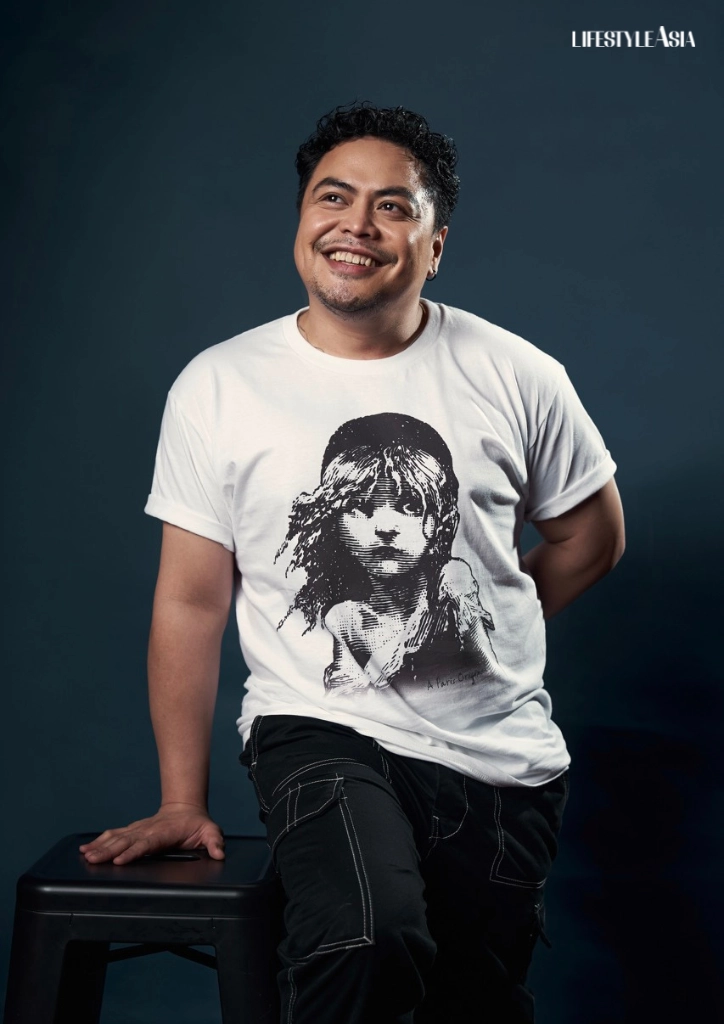
Red Concepción might play the other half of the messy, toxic comic relief couple in Les Misérables, but there’s an impressively composed way in which he answers questions. He weaves in clever metaphors, makes sure he covers every point, and even asks if his answers are satisfactory (they’re more than satisfactory). He’s an actor who, even amid laughter and levity, approaches his craft seriously: as an exercise, a muscle, a multidisciplinary practice that’s never isolated from human behavior and philosophical thought.

In the same vein, Lea Salonga jumps straight into the interview, refreshingly casual yet thoughtful in her responses. She carries both a storied life and career: one that’s global yet rooted in her home country, a long thread she pulls from as she reflects. Yes, she and Red are clearly having fun playing the antagonists onstage, but behind the curtains, she stays true to her personal values, to what it means to be both actor and person—all the complexities included.
How does humor highlight cruelty?
Red: Practically, it adds a bit of levity to the show. I mean, Les Misérables has such deep and dark themes. As an audience member, you need a little break from it all, and that’s what the Thénardiers provide.
They’re in stark contrast to Javert—who’s more, I guess, recognizably cruel. It’s always easy to find cruel people when they’re brooding. But the Thénardiers make audiences think, ‘Oh, wait a minute…should I be laughing at this?’
Evil is dressed up in very palatable ways. Evil people aren’t always going to look like villains. Most of the time, they’re going to be the most charming, charismatic people. It makes you realize that you need to be more vigilant. Like that quote from the Bible: “Be innocent as doves, but wise as serpents.” Do good, but also recognize that not everyone is going to have good intentions.
Lea: It’s interesting, you know. The comic relief for Les Misérables happens to be the two most cruel, opportunistic, greedy, unscrupulous people out there. But why is it comedy, really? It was tricky thinking about this question, because they’re just a ball to watch. We’re [her and Red] having a blast. I often joke around, I say ‘I’m in my villain era.’ But look at characters like The Joker. He’s inherently a clown, but he’s a sad clown, someone cruel. When you use humor, I don’t think it necessarily diffuses the cruelty, it just makes an audience have an easier time looking at it; if it’s all just cruelty, cruelty, cruelty, the tendency might be to look away, because it’s too much. But when there’s humor that draws you in, it highlights the situation; it just helps the audience look at what needs to be looked at.
Is greed learned or instinctive?
Red: What is instinctive is self-preservation. I think that’s what we’re born with. We want to stay alive; that’s innate in all living creatures. Greed, and the opposite, generosity or sense of community, that’s what we learn. We need to live, but other people also need to live and have a share of the resources. What happens is, when your instinct of survival and self-preservation gets corrupted, then it turns into greed. I guess it’s a question of nurturing—what your society has made you, which will push you one way or another.
Lea: As an actor, I was trained to be generous, to always be there for my scene partner, to learn to ask the questions: What do you need? What can I give you? So greed doesn’t compute. You always have to be ready to catch someone; and if you’re stumbling, the other person should be able to catch you.
So when you get to play something like this, you either tap into something that might be present, or you watch others—whether you take them from the news, people your parents are friends with, or you just find yourself around these kinds of folks. You have to be sensitive enough to pick up on an energy like that. I think the news is rife with people like that.
It makes you think, how is anybody this evil or greedy? It’s like that thing when you’re eating, and you’re full, and your body knows it’s had enough. How is that not present in a human being we identify as greedy? Is it just completely absent? Was it always absent? Was there a time when enough actually was enough? When did that impulse start to grow in certain human beings? These are interesting questions to ask.

What’s ambition without conscience?
Red: I believe that would be chaos. I think all traits have a ‘basement’ and a ‘penthouse.’ You could either go up or down the extremes. Love could become nurturing, or it could become obsession—it depends on which way you decide to take the elevator. Ambition: when you take it up to the penthouse, you become a better person. You learn to grow. You realize you have a place in society, that your goals reverberate in the world you live in. But if you take it to the basement, then that’s where you’re only out for yourself, where being cutthroat and stepping on other people without conscience comes in.
A good thing about this show is that you realize, and I keep saying this, that justice has to be tempered with mercy. You have Javert, who’s so rigid and single-minded, so sure of his beliefs and his righteousness, and that ultimately destroys him and the people around him. Then you have the Thénardiers: these merciless, godless people who are out for themselves—that’s the basement.
Lea: Personal ambition—wanting to succeed, wanting to make your dreams come true…well, I’d like to think that in order for anyone’s dream to come true, there needs to be a village surrounding them, in which case you’re always conscious of how it will affect other people. You have to have some sort of conscience, if only to be aware that you’re not alone in your pursuit of whatever it is you envision for yourself as a successful human being.
I didn’t grow up with this feeling of entitlement to anything. I’m raising my child [actor Nic Chien] that same way: ‘You’re not entitled to anything. You have to work for everything you get.’ So, off he goes to auditions. Even when we play card games or board games, I’m like, ‘No kid, I’m not letting you win. So when you do win, you never ever have to question whether you deserved it or not.’
Ambition without conscience comes across as, ‘I will do whatever I want. Never mind the collateral damage, never mind how anybody else is negatively affected by my pursuit.’ That doesn’t sit well with me. It just feels really selfish. It feels absolutely terrible to pursue something with no regard for how it will affect another person—it’s absolutely horrible.
To Be In Les Misérables Is To Be…
What emerges from this string of interviews are rich impressions of the players that make up one of the world’s greatest musicals, drawn from people who continue to give them breath and relevance, time and again. The line between actor and character proves to be a paradoxical thing, simultaneously delineated and blurred, varied perspectives ultimately dissolving into a shared understanding of what it means to love, desire, covet, hurt, lose, grieve, start over, break free, and sing your song as you endeavor to find yourself in the mess of the world—which is pretty much what it means to be human.
Photography by Kieran Punay of KLIQ, Inc.
Hair and make-up courtesy of GMG Productions
Shot on location at The Theatre at Solaire
Frequently Asked Questions
Les Misérables: The World Tour Spectacular is an expanded staging of the Les Misérables Staged Concert, which ran for over 200 performances in the West End. The Manila production ran at The Theatre at Solaire from February through March 1, 2026, featuring a full orchestra, new set and lighting designs, and a star-studded international and Filipino cast.
The Manila production featured several notable Filipino performers, including Lea Salonga as Madame Thénardier, Rachelle Ann Go as Fantine, and Emily Bautista as Éponine Thénardier. Red Concepción played Monsieur Thénardier alongside Salonga.
Rachelle Ann Go said that becoming a mother herself has deepened her connection to Fantine’s sacrifice and devotion. She described motherhood as unconditional love and the most humbling role she has known, and reflected that she relates to Fantine’s pain and struggle every night she performs — finding in the character a mirror to the exhaustion and fulfillment of raising a family.
Lea Salonga and Red Concepción reflected on how the Thénardiers use humor to make the audience confront cruelty more directly. Salonga noted that comedy draws audiences toward what might otherwise be too difficult to watch, while Concepción observed that truly dangerous people are often the most charming — and that the Thénardiers embody ambition without conscience, which he described as chaos.
Emily Bautista defined loneliness as “not being seen” — a condition she described as central to Éponine’s experience. She reflected that Éponine exists between two worlds she never fully belongs to, unseen by both Marius and her own family, and that this invisibility makes her the character in Les Misérables who most embodies what it means to go unrecognized for who you truly are.