
Alejandro G. Iñárritu’s black comedy isn’t particularly comedic, but makes some commendably bold creative choices, its commentary on our relationship with art in crisis more intriguing than that of the ecological disasters at its forefront.
Digger begins with curtains drawing open, oil tycoon Digger Rockwell (a pruny Tom Cruise) staring into the seemingly idyllic, sunrise-drenched world before his large bedroom window. In hindsight, that should’ve clued me into the clever sleight of hand director Alejandro G. Iñárritu would pull, the film’s biggest twist already foreshadowed yet flying over our heads, ready to pull the carpet from under us a little over 20 minutes into the film.
I’ll leave it at that, because that’s the moment when what seemed to be a cookie-cutter, tediously over-the-top ecopolitical satire of greedy megalomaniacs managed to fool me completely. It got me sitting up straight and alert from my post-dinner stupor; the friend I attended the press screening with was noticeably more curious than a few minutes prior. “Now, it’s interesting,” he tells me. And it does get interesting, but it can’t shake off its oftentimes exhausting attempts to be heard, screaming through the din of the many things it’s trying to say. Still, it makes some applaudably gutsy choices and presents us with eye-catching visuals that are worth seeing.

READ ALSO: Film Review: “Forgotten Island” Spins Vibrant Takes On Philippine Mythology And Folklore
Digger Rockwell Enters The Scene (And Steals It)
Cruise’s performance is one of the things I liked best about the film; he doesn’t hesitate to give it his all, fully immersing us in the peculiarities of his larger-than-life character, a wealthy Southern oil tycoon whose ceaseless operations in an Arctic rig in Greenland cause a series of major ecological disasters (surprise surprise).
The tycoon truly believes, as we expect him to, that oil is the life-sustaining milk of Mother Nature (my rephrasing of an actual line he delivers with his whole chest). He’s selfish and ridiculous, oxymoronic in that he couldn’t care less if the world burned, yet he still attempts to convince people that he has their best interests at heart. Even with all the exaggeration, Cruise manages to balance the act, keeping us on our toes as he sustains the film’s Surprising Twist, a reveal I don’t think would’ve worked without his commitment to the bit.
Digger is a fascinating man; a prick, yes, but not a one-dimensional one. The film opens with him tenderly cradling his beloved cat, a near-corpse who pisses and defecates all over his bed yet is never on the receiving end of the temper or narcissism he shows everyone else. And if you think that eccentric subversion is cliché, don’t worry: the twist gives you another layer to chew on, with Cruise morphing and proving pliable as clay, moving from one beat to another in a way that makes you forget what’s real and what isn’t. It’s more than enough to remind you that, despite his long stretch of blockbuster action movies, the actor hasn’t lost his subtle touch in auteur-driven dramas.

The film’s impressive set design, under production designers Dennis Gassner and Richard Johnson, as well as its cinematography by Oscar-winning director of photography Emmanuel Lubezki, also help carry the odd narrative framework. Like a well-oiled machine, its moving parts click together, serving as focal points of the plot when needed before retreating into the backdrop, but always guiding our eyes through changing moods and atmospheres, whether that’s the lonely sprawling rooms of Digger’s mansion, a ghost-pale courtroom, an army plane, or a dingy boat cast off into the sea. The shots and sets play tricks on your eyes, with the time of day and weather obfuscated most of the time unless there’s a window or door, a choice that builds on another intriguing reveal by the film’s end.

Making Digs, But The Shovel Doesn’t Quite Land
Digger makes its digs (yes, pun intended), but despite the “comedy” in its genre, it gives us very little to laugh at. The jokes don’t really land, even as they’re delivered with indefatigable verve, lending the film a tilted, awkward air that often feels forced and tiresome, my mind drifting at certain points. That Surprise Twist softens this criticism, but only slightly, and I’m beginning to wonder if it’s a crutch or cop-out.
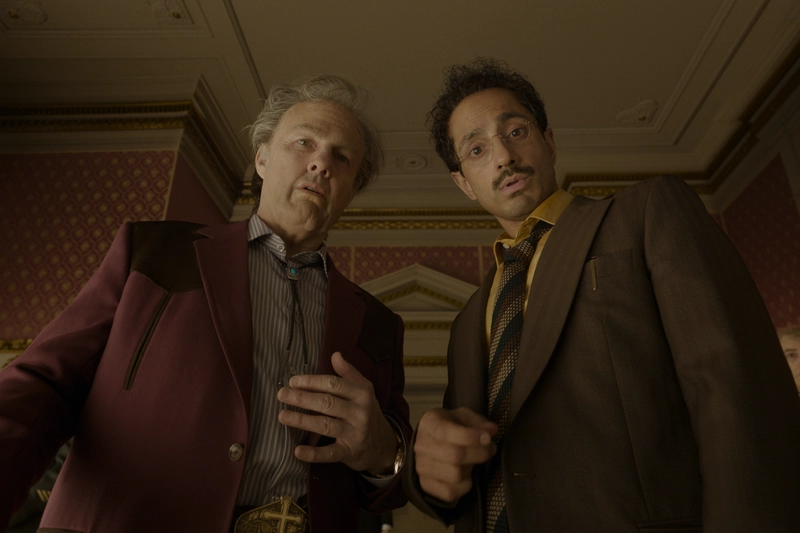
I’ll acknowledge that maybe I don’t share its sense of humor, but despite its stacked cast of talented stars—Riz Ahmed, Sandra Hüller, and Jesse Plemons, for example—the ensemble fails to deliver particularly commendable performances, with some, at best, underutilized and, at worst, underwhelming.

Much of the story involves an all-too-familiar group of American leaders (played by middle aged white men, of course) doing what they do best: bombing every threat, making insensitive jokes, screaming until their veins pop, and believing they’re the center of the world. It’s realistic, it’s on the nose, it’s caricaturized, it’s laborious to watch (John Goodman playing an ever-vitriolic President of the United States who makes the same butt-related reference several times). All these things can be true at once.
A Disaster Movie That Isn’t Really About The Disasters
Digger’s Surprise Twist (with how often I’ve mentioned this, I’m as tiresome as Goodman was with those gratuitous butt references) doesn’t actually strengthen its ecopolitical satire, but rather uses it to redirect our attention to its less obvious conversation, the one I find more thought-provoking: the role of art in our lives, especially during times of tumult. Again, I can’t discuss things further without giving away the film’s best part, but let’s just say it’s a disaster movie where the disaster is a mirror, one where we can see both the futility of art in crisis and its necessity.
As the overly stated Joan Didion quote goes, we tell ourselves stories in order to live. They might be as close to facts as can be, and they might be distortions, but either way, controlling the narrative becomes our way of regaining some semblance of autonomy amid the uncontrollable circumstances before us: to maintain our power, to render the powerful as powerless, to find the comedy in tragedy, to imagine worlds far different from our own. Digger also makes a point about just who gets to support and champion art, why they do it, and how that changes its significance in implicit ways.

All that said, the film gets too caught up in its own clever tricks and relentless satire, as it never really lets these interesting points breathe, and can’t seem to choose what it wants to talk about. The matter it’s waving in front of our faces—ecological disasters we’re all witnessing today and the same circus of people making the big decisions—feels like a secondary idea that falls flat against the far-reaching, expansive complexities of our current reality, even if it’s at the forefront of the film.
I would’ve preferred a more sharply rendered, subtle exploration of its ideas about art than all the screaming politicians. In other words, it’s the news with nothing new to say; though thanks to some unexpected choices, a few strong performances and beautiful visuals, it has more than a few things to show.
“Digger” is now screening in Philippine cinemas
All photos courtesy of Warner Bros. Pictures
Frequently Asked Questions
Digger is Alejandro G. Iñárritu’s black comedy about oil tycoon Digger Rockwell, played by Tom Cruise, whose operations at an Arctic rig in Greenland cause a series of major ecological disasters. While the film presents itself as an ecopolitical satire, its Surprise Twist redirects attention toward a deeper conversation about art, storytelling, and their role during times of crisis.
Tom Cruise plays Digger Rockwell, a wealthy Southern oil tycoon whose larger-than-life personality and eccentricities make him one of the film’s most memorable characters. The review highlights Cruise’s commitment to the role, particularly his ability to move between exaggerated and subtler moments as the film’s story unfolds.
Although Digger is classified as a black comedy, the review finds that it offers relatively few genuine laughs. Its jokes are often delivered with considerable energy, but many of them feel forced or tiresome. The film instead leans heavily into satire, particularly through its portrayal of American political leaders and powerful figures.
The review deliberately does not reveal Digger’s Surprise Twist because it considers the reveal one of the film’s best parts. The twist arrives a little over 20 minutes into the film and changes how its story and characters are understood. The review also argues that Tom Cruise’s performance is essential to making the reveal work.
Beyond its focus on ecological disasters and political power, Digger explores the role of art and storytelling during times of crisis. The film considers how narratives can help people regain a sense of autonomy, find comedy in tragedy, imagine different worlds, and determine who gets to support and champion art. The review finds these ideas more thought-provoking than the film’s more overt ecopolitical satire.