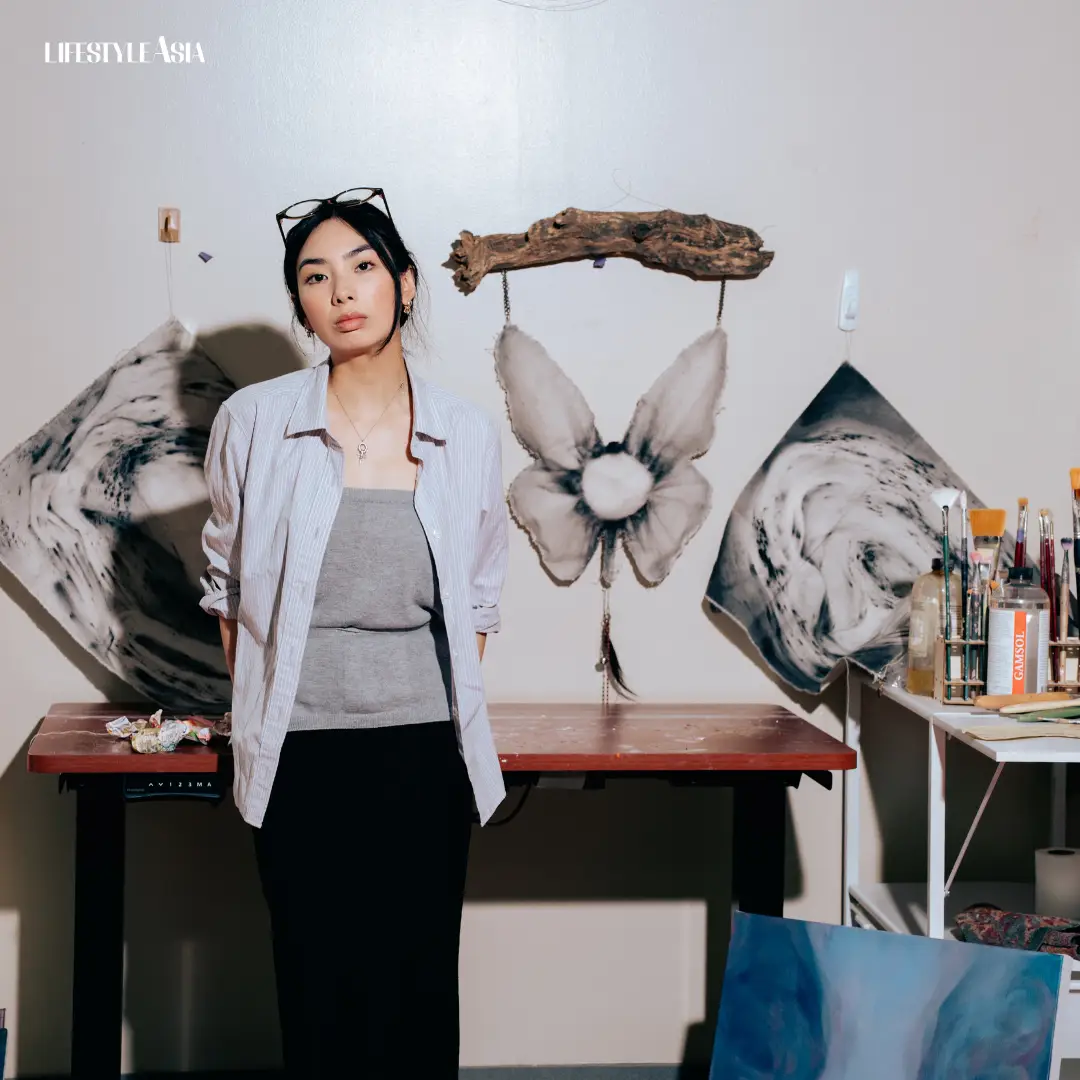
The 27-year-old artist talks to Lifestyle Asia about her debut exhibit, “Desire Forms,” which explores and evokes the contradictory nature of desire.
In Ancient Greek, according to C.S. Lewis, four words roughly translate to the English word “love.” There’s storge (familial love), philia (friendship as a form of love), agape (selfless love or charity), and finally, eros (sensual or romantic love, and from which the word “erotic” is derived). It’s this last form that offers perhaps the most complex understanding of human love, longing, and desire.
In Eros the Bittersweet, classicist Anne Carson writes that the Greek concept of eros denotes “want,” “lack,” and “desire for that which is missing.” “The lover wants what it does not have,” Carson continues. “It is by definition impossible for him to have what he wants if, as soon as it is had, it is no longer wanting.” In this sense, the artist and her audience become a pair of lovers, forever reaching toward connection and understanding. Art exists in the gap between.
“A lot of my thinking around this exhibit has emerged from Anne Carson’s treatise on desire, Eros the Bittersweet, which characterizes it as a simultaneous experience of pleasure and pain,” explains artist Martine Velasco, whose debut solo exhibition Desire Forms opens at The Crucible Gallery this month. “Using this thesis as a framework, I wanted to explore the more paradoxical and enigmatic side of desire, depicting it in a way that’s removed from stereotypical crudeness.”
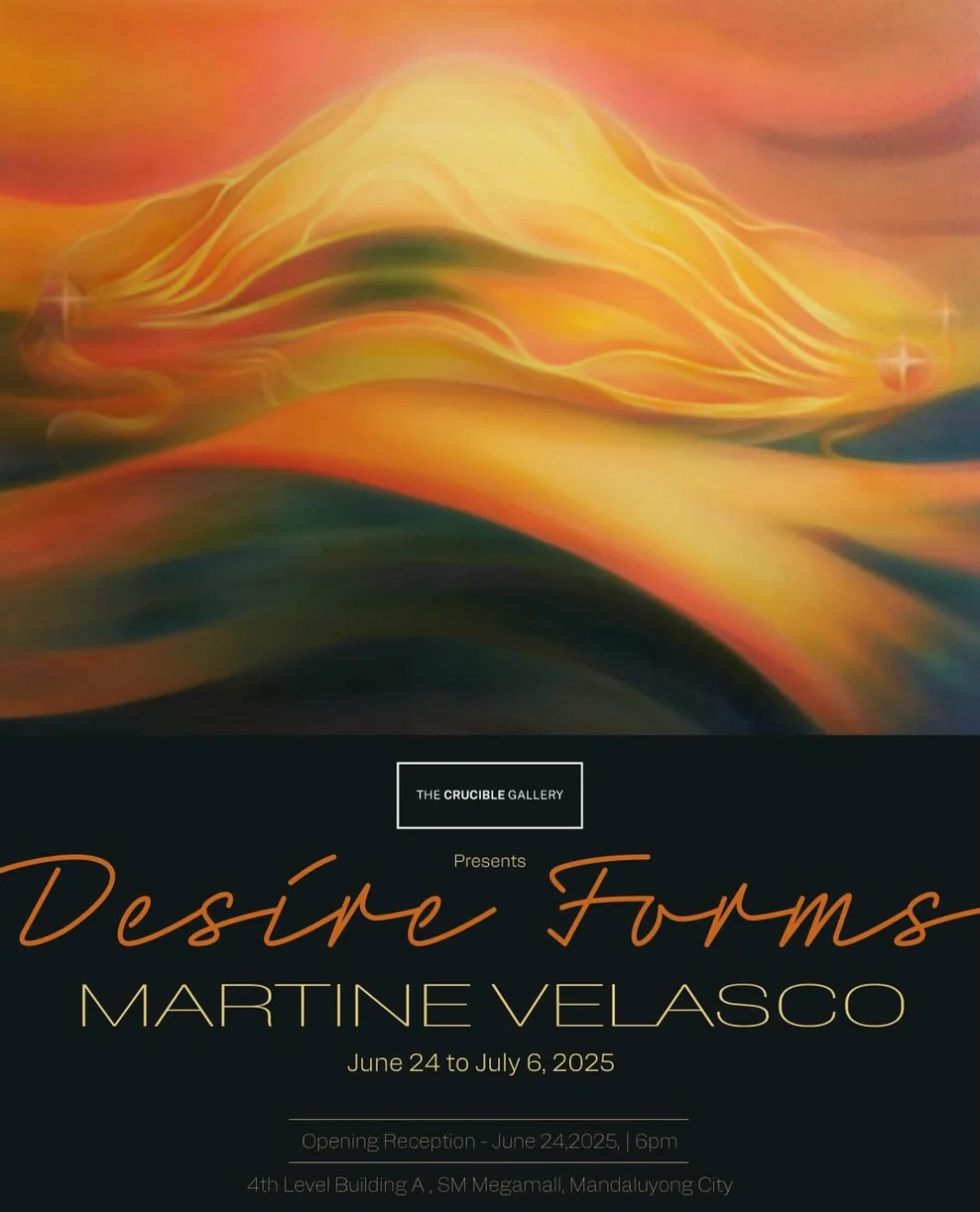
For her exhibition, the 27-year-old artist has created works in both painting and sculptural media that embody this understanding of desire’s contradictory nature. Art that makes us feel the bittersweet nature of longing rather than simply observing it.
READ ALSO: In Our Stillness: Sa Tahanan Co.’S Echoes Of Home
From Mother’s Palette to Personal Practice
“I was introduced to art primarily by my mother, who was a talented painting hobbyist,” Martine shares with Lifestyle Asia. “There wasn’t a pivotal moment as much as a natural aptitude that I developed over the years. Although I have been drawing and painting since I was very young, I first considered professions in the fashion and creative writing industries. I did not consider a serious career in art until about halfway through college.”
This natural aptitude led Martine to complete a B.F.A. in Studio Art from New York University, where her focus was on drawing and printmaking. These traditional two-dimensional media would soon give way to something entirely different. “When I was younger, I wasn’t as interested in sculpture, which is ironically one of my primary mediums now,” she says. “Naturally, I’ve spent quite a bit of time expanding my skill set, but it’s a rewarding process that really motivates me as an artist. Other hobbies I’ve developed, such as jewelry making and sewing, have also informed my foray into the 3D world.”
After graduating, Martine returned to Manila and began developing her latest practice: transforming found objects into art. Her collecting process became almost ritualistic as she wandered through family gardens and provincial properties, searching for materials that others might classify as waste, but that she recognized as carriers of history and energy.
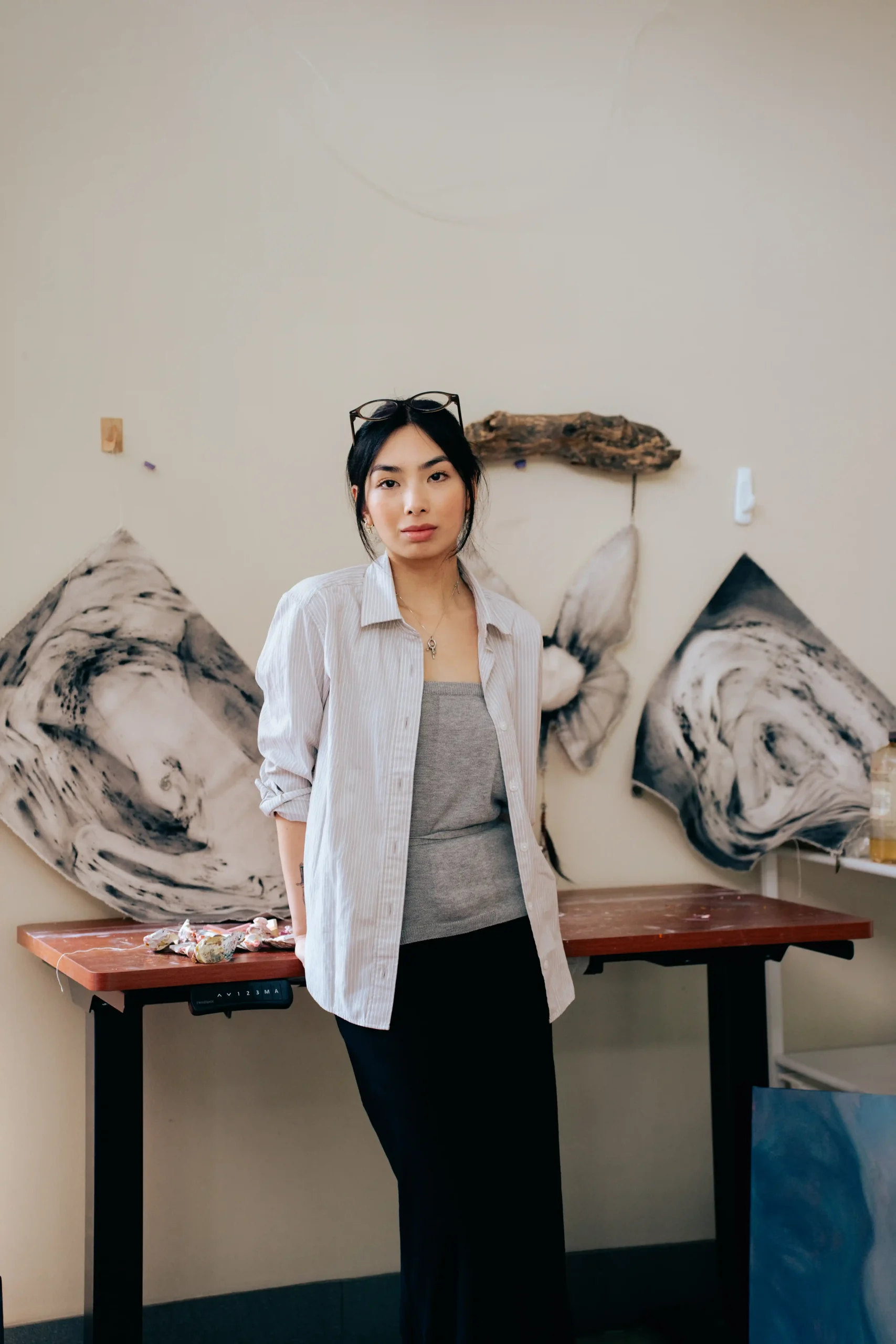
“Nature has played a larger role in my practice since moving back to Manila,” Martine says, “Not only in terms of material and subject matter, but also through the philosophy of nature-based theologies. Further educating myself on the cultural foundations of our country has profoundly enriched my work.”
This development toward found objects and natural materials has also led to developments in her artistic practice and understanding of how art engages with memory, place, and meaning. “I take inspiration from mythology, relics, and folk practices, combining elements of my ancestral history with personal motifs to create intentional objects that engage with the psyche,” she adds.
Inside the Garden of Pain and Pleasure
This connection to nature and found objects became the foundation for how Martine would approach the concept of desire itself. Perhaps no allegory for desire is more enduring than the garden, echoing since the slither of a snake and a bite of an apple in Eden. For Martine, the garden isn’t merely metaphorical, but also the literal source of both her materials and her conceptual framework for Desire Forms.
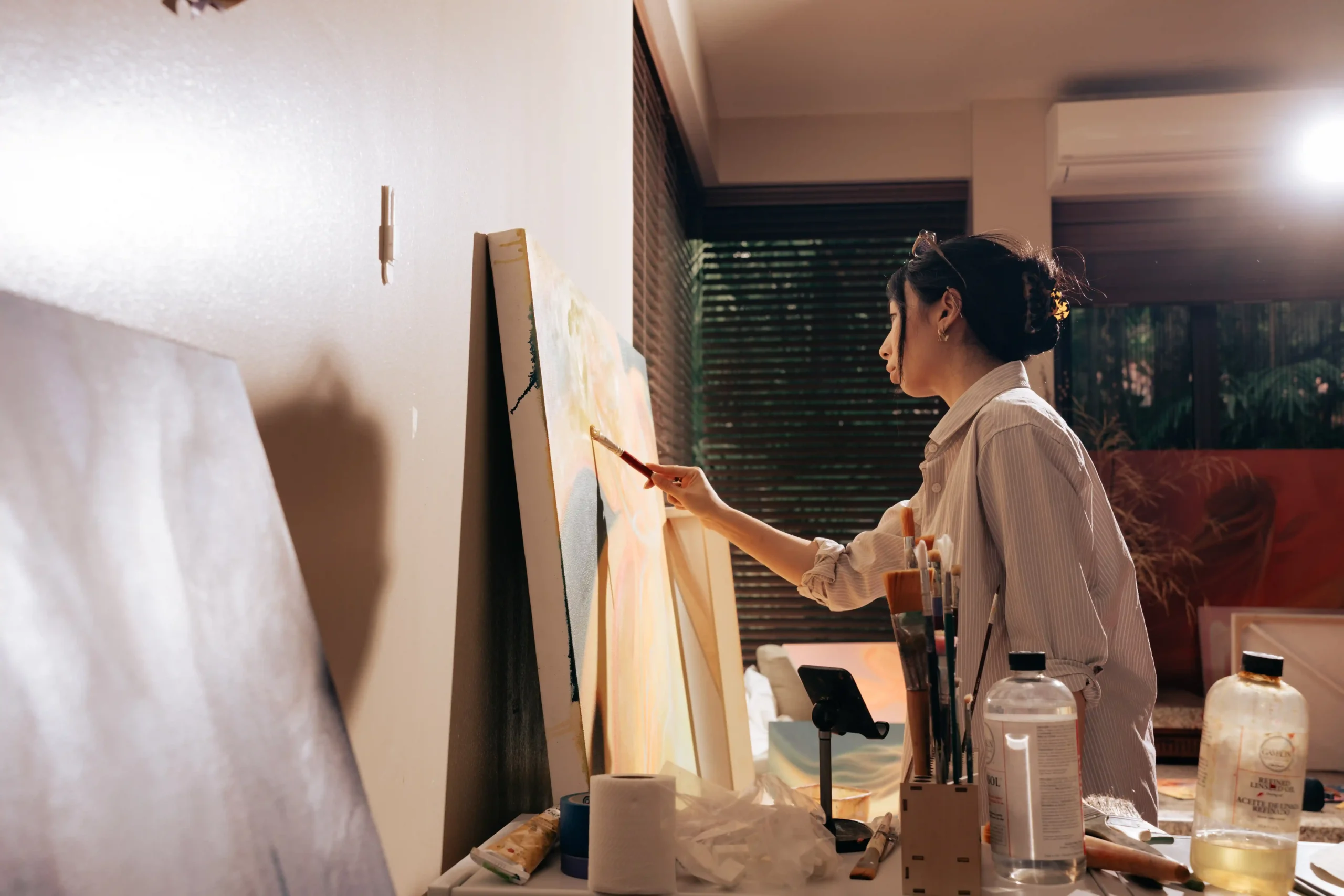
“I’m interested in the histories of material objects,” she explains. “I think there is a special unnameable quality to objects that have been exposed to certain energies, objects that hold sentimental value.” She prefers aged and discarded objects, items that she views as repositories of memory and meaning. “It brings me a lot of joy to give objects a new life, and, in the process, redefine what constitutes waste.”
This methodology extends Carson’s understanding of desire as existing in gaps and absences, allowing her to explore the subject in a way that transcends cultural taboos and stereotypical representations, without relying on the human form.
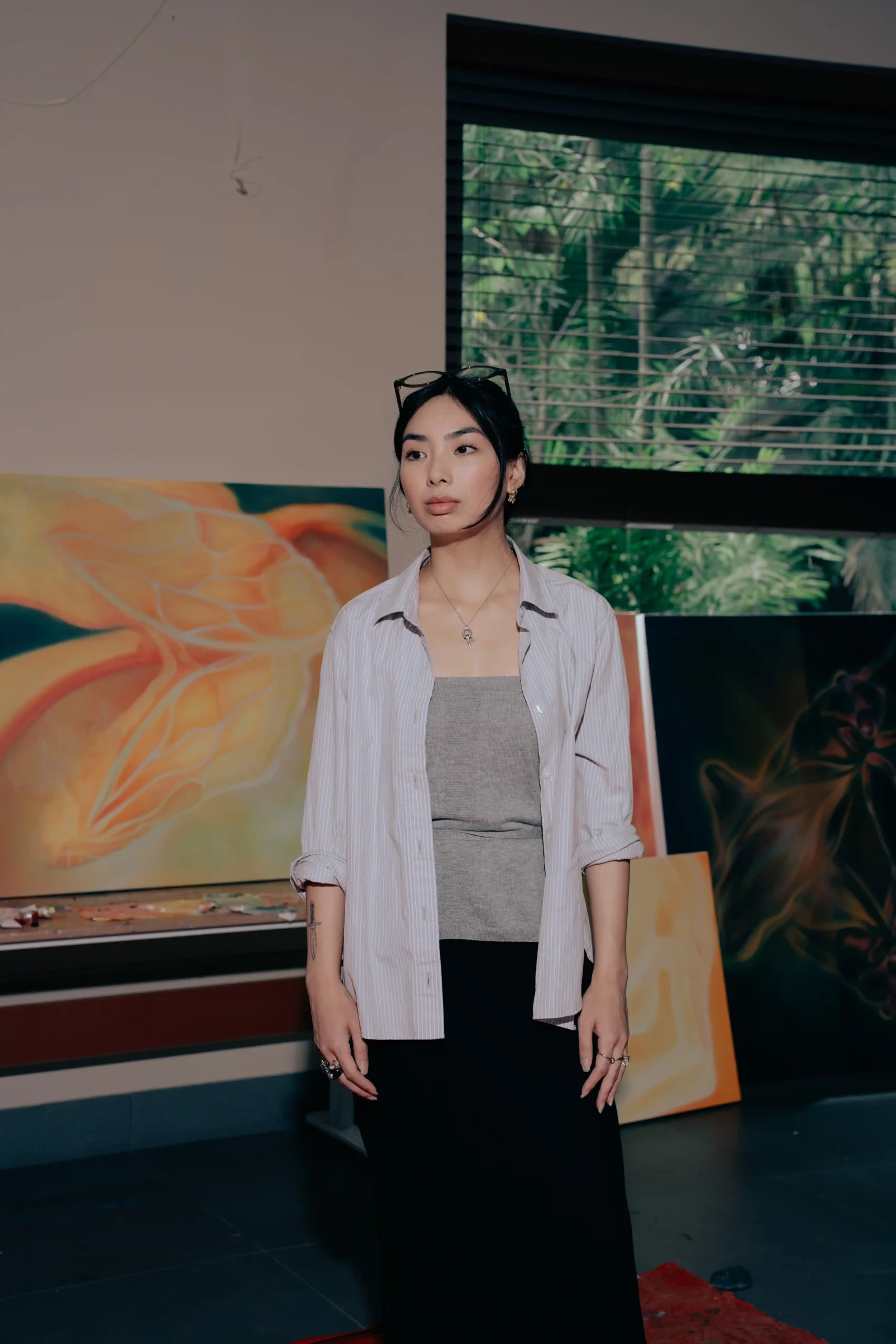
“The concept of desire can be warped in a culture dominated by dogma. I wanted to approach it from a more nuanced perspective, where the human form is completely omitted and the focus becomes these moments of intimate connection, colors that energize the body, the tension of contrasting materials,” she explains. The cicadas she grew up hearing in her family’s garden become ethereal paintings of mating bugs, radiating with intense colors that transform biological function into something transcendent.
Meanwhile, her sculptures embody the material contradictions that define her practice: constructed from salvaged, weathered objects yet emanating organic sensuality, their ruggedness undercut by unexpected grace. This approach allows her to create what she calls “intentional objects that engage with the psyche.” These are works that bypass literal representation to access something deeper about the nature of longing and desire itself, yielding layered meanings where new significance builds upon the accumulated history of discarded materials.
“Desire Forms” at The Crucible Gallery
Desire Forms, running at The Crucible Gallery from June 24 to July 6, 2025, features 10 pieces that demonstrate the artist’s unique approach to desire’s complexities. The exhibition includes five paintings from a series she’s been developing since 2022, alongside five new sculptures created specifically for the show. What visitors encounter are not traditional desire representations, but an exploration of how longing feels.
The works themselves embody what Martine identifies as the defining characteristic of her practice: duality. “I’ve found that there always seems to be an element of duality in my work,” she explains. “It has manifested in the literal form of twin or oppositional figures, as well as the more figurative sense, like through material/textural contrast and symmetry.” In Desire Forms, this duality becomes the vehicle for exploring Carson’s understanding of desire as simultaneously pleasure and pain, the wanting and the longing.
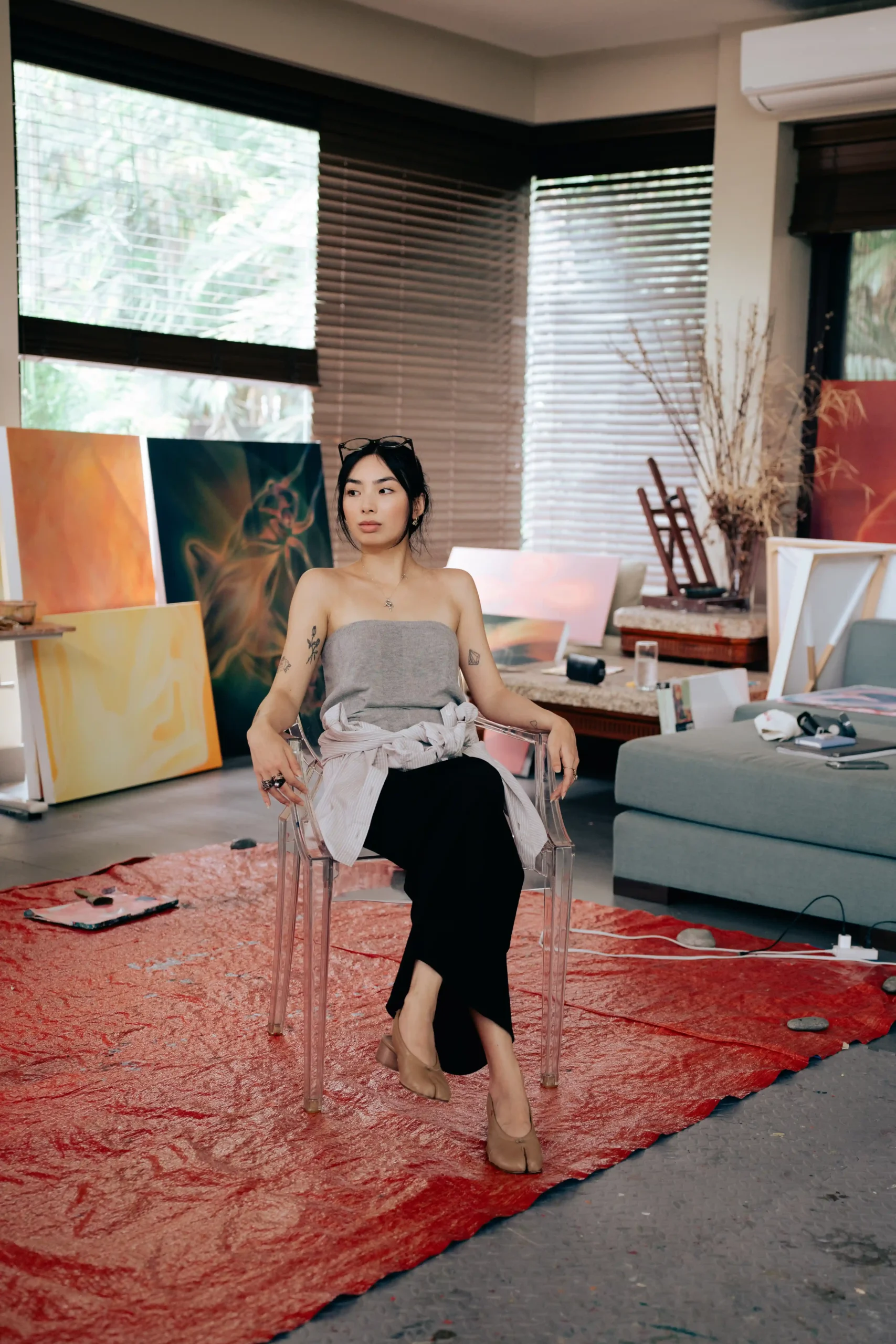
But Martine’s interests extend beyond simple oppositions. “Concepts that exist between or outside of the binary of duality also interest me, including transformation, paradoxes, and divinity,” she adds. And this exhibition finds its depth in those spaces of transformation and paradox, creating the very conditions Carson describes for eros to exist. Like the triangular relationship between lover, beloved, and the essential gap between them, Martine’s work positions itself between artist and audience, requiring that space for meaning to emerge. Or, if not meaning, emotion.
“I’m not necessarily after a moral or message,” she says. “I’m more interested in whether my audience forms an emotional resonance with the works. I feel that is more true to the nature of desire itself, which tends to resist a fixed definition.”
“Desire Forms” will be on view at The Crucible Gallery on the 4th Level, Building A, SM Megamall, Mandaluyong City from June 24 to July 6, 2025.