A new wave of runners is running for connection, purpose, and something greater than themselves.
Running is experiencing a resurgence—not just as a sport or recreational hobby but as a global cultural and wellness phenomenon. The social activity tracking app Strava has more than 135 million active users, and on the platform, “kudos” have become the new likes. From New York to Manila, run clubs have become the new social clubs and dating apps. Marathon participation is also at its all-time high. Just this April, 56,640 participants finished the London Marathon—the highest number of marathon finishers for a single event, a record that has been broken three times in the last year (previously by the 2024 Paris Marathon and the 2024 New York Marathon).
The boom is fueled by a new wave of runners led by Gen Z. The sport is seeing a dramatic demographic shift. Race participation among Gen Z runners has surged, with marathon attendance up 60% and half-marathon entries up 68% this year alone. Back in 2019, only 15% of finishers at the New York City Marathon were in their 20s—by 2024, that number had climbed to more than 22%. The gender gap is narrowing too, as more young women take to the roads in record numbers. According to Strava, women under 25 are the fastest-growing community on the app and the most likely to be tracking their runs.
Once viewed as the domain of elite athletes chasing medals and records, or as a form of physical punishment—often dreaded in gym class or used as a tool for weight loss—running is now being re-embraced by people from all walks of life. At its core, running is deceptively simple. One foot in front of the other. Which begs the question, why is everyone running?
READ ALSO: Sober Curious: The NoLo Movement Changing How We Drink
Running Through A Global Pandemic
The resurgence of running didn’t happen overnight. It started quietly, back in the early days of the COVID-19 pandemic, when gyms were closed, group classes were canceled, and people were desperate to move. Running offered a rare kind of freedom. It was the perfect pandemic sport: solo, outdoors, and physically distanced. All you needed was a pair of shoes.
More than just a way to stay physically fit, running became a type of mental therapy. With routines upended and anxiety running high, running offered structure and stillness. There’s something meditative about the rhythm of your feet hitting pavement, the way your breath starts to match your stride. Each step pulls you back into the present, a way to escape the pending Zoom calls and anticipation of the next potential lockdown. It gave people somewhere to go, even when the world had come to a standstill.
According to Nielsen Sports Research, over 90% of those who took up running because of COVID-19 intended to carry on after the pandemic. True enough, as the world slowly reopened, running didn’t fade—it evolved.
Pain Is Temporary, Strava Is Forever
Running, particularly during the pandemic, was often a solo pursuit. So, how did it become a global movement?
The answer, in large part, is social media. Strava CEO Michael Horvath says that during the pandemic, people began to “look for community and connection when they couldn’t find it through their regular life.” What better way to feel connected with people than by viewing their physical efforts, giving virtual high-fives in the form of “kudos”.
“People keep people active,” Horvath says—and the app is built around that idea, offering motivation, discovery, and a sense of shared purpose.
At the same time, the rise of the “runfluencer” on Instagram and TikTok brought running into the spotlight for a new demographic. What began as running posts and stories—filling the void left by travel, parties, and other shuttered experiences—evolved into a full subcategory of creators centered on running. These creators—whether seasoned marathoners or casual joggers—document their training, gear, and race-day highs, influencing how and why others run. Platforms like Instagram, TikTok, and especially Strava have turned individual runs into collective experiences.
In short, we run because we see others run. This craving for connection was enough to get us lacing up our shoes and stepping out the door—uploading this on Strava afterwards, of course!
Manila’s Hottest Club Is… A Run Club?
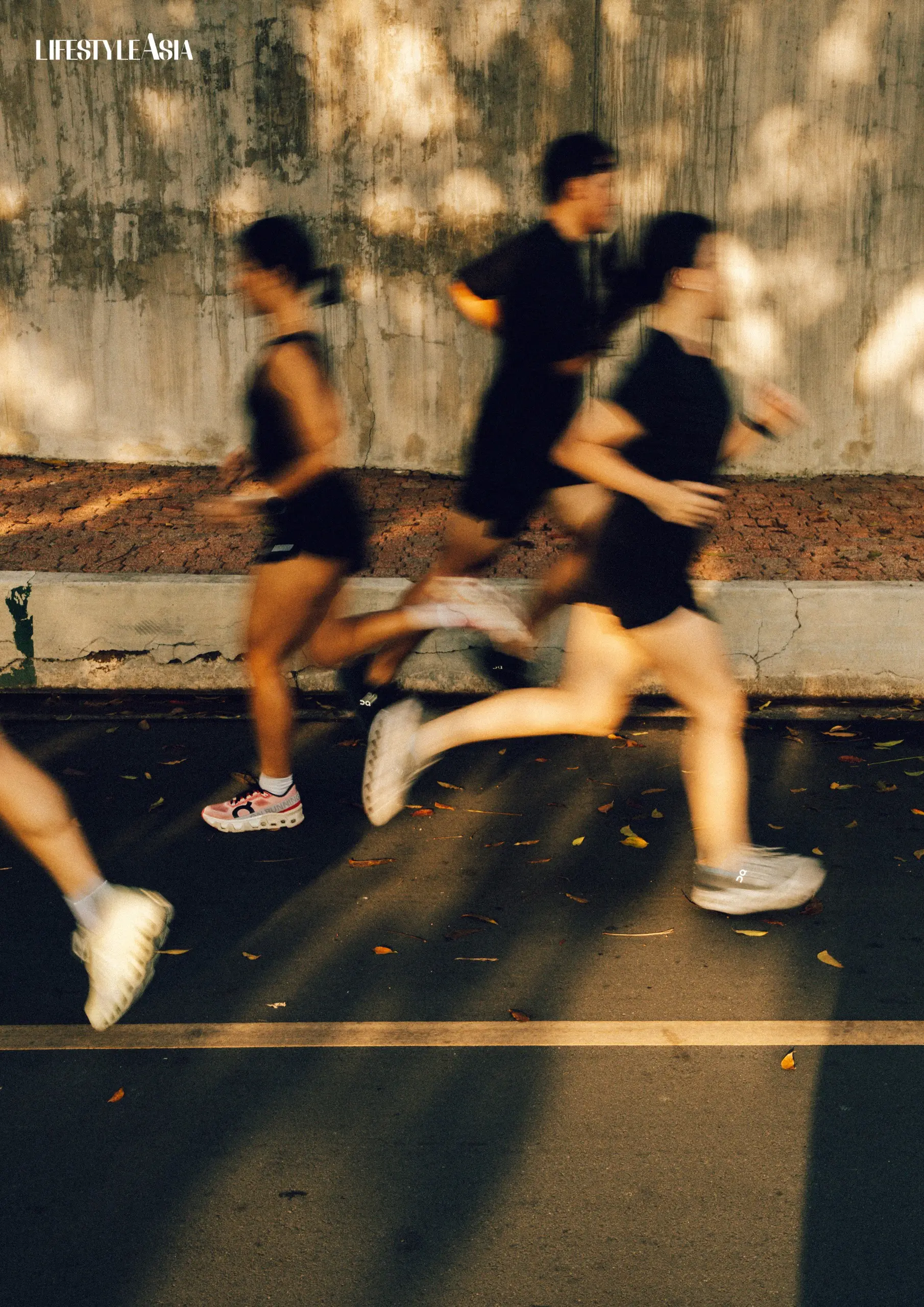
To the non-runner, it seems hard to believe that thousands, even millions of people, would willingly put their bodies through physical discomfort for the purpose of… connection? However, the rise of run clubs says otherwise.
According to Strava, making social connections is now a leading motivator for people to work out. In their recent annual report, they found a 59% global increase in running club participation last year. Among those surveyed, over half said they made new friends through fitness groups. This statistic rises to two-thirds when isolating Gen Z.
Run club founders say the appeal goes beyond physical health; it’s the emotional bond formed in motion and perhaps the vulnerability in difficulty and challenge. “What keeps people involved is the authenticity,” says Justin Lu, founder of The Usuals. “You can’t fake effort in the middle of a hard session—there’s no hiding behind filters, titles, or ego.”
As another run club organizer puts it: “Religion gives you a group of people who are willing to take action and help you… the run club gives you that, too,” with Sunday long runs being the congregation of choice (just check out Ayala Triangle on a Sunday morning).
The opportunity for connection is so strong that it has transcended to romantic connections. In that same study conducted by Strava, nearly one in five Gen Z individuals surveyed said they dated someone they met through exercise. They also found that Gen Z was four times more likely to want to meet people during a workout than at a bar.
But let’s give run clubs more credit. They are not just social hubs but also provide effective performance conditions. Having a group to train with does more than justmake you feel connected; it actually helps you run better. Studies show that 43% of people join group workouts to improve their performance, while 34% say it helps them stick to their training plans. There’s power in accountability—a friend waiting at the crack of dawn makes you far more likely to show up. And once you’re there, the benefits stack up. “It’s about consistency, getting stronger, and getting faster, together. That mindset is infectious,” says Justin.
Structured sessions with experienced coaches, exposure to new routes, and the gentle push to keep pace with the pack all translate into tangible gains. In fact, data shows a 40% increase in workout duration when more than 10 people are involved. Sure, some of that’s chika time, but if it keeps people moving longer, then who’s to complain?
What’s emerging is a new kind of flywheel effect: social connection drives consistency, which fuels performance, which in turn makes people want to keep coming back. From a solitary activity, running has become a new gathering place—sweaty, sincere, and surprisingly intimate. Running is also a performance-boosting engine—one that’s creating a self-sustaining cycle of motivation and improvement.
Running The Distance
Our social media feeds are filled with invitations to run clubs, screenshots of their routes and running times, and most notably, people spending their weekends taking part in races—anything from a 5k to a marathon. Running, specifically racing, feels ubiquitous. Yet, just a decade ago, the running world was in decline.
According to Running USA, race participation dropped 9% in 2015 after 20 years of steady growth. The Wall Street Journal even declared that millennials had ended the running boom. Between 2013 and 2015, frequent running among adults aged 18 to 34 fell dramatically, by as much as 22% among the youngest group. Millennials de-emphasized competition in sport as a whole, which led to the rise of non competitive experiences that focused on participation and fun (throwback to the era of color runs and zombie races).
But this new wave of runners are rewriting the story. 21% of runners on Strava ran at least one race in 2023, a 24% increase over 2022. But these runners are not only showing up in record numbers—they’re taking on greater challenges and chasing longer distances. Marathons have become so popular since the pandemic that the Abbott World Marathon Majors has added a new race for the first time in 12 year—the Sydney Marathon happening this coming August. Locally, the Bull Run Dream Marathon, targeting first time marathoners, saw its participation soar from just over 250 in 2010 to over to 2,000 in 2025. According to Strava, Gen Z runners saw the greatest percentage of growth in race participation this year, with a 60% jump in attendance at the marathon distance and a 68% increase at the half-marathon distance.
Why is this happening? Are younger generations just more competitive? Many sources indicate that Gen Z is indeed more goal-oriented compared to previous generations. Contrary to popular belief, younger generations care. They care about competition and performance, with the underlying hypothesis that they thrive to better themselves and view running as milestones. This is often attributed to their upbringing in a competitive and rapidly changing world, where success is frequently measured by achievements and a strong sense of purpose. Therefore, this new wave of runners are not only running for participation, but also a personal drive for self-betterment.
READ ALSO: Boston Marathon: My First Run To Boylston Street
Marriage, Mortgages, And Marathons?
But to provide a contrarian perspective, the reason behind this new wave of runners may not be so rosy. In 2024 alone, there was a 9% increase in the number of marathons, ultras, and century rides logged globally. On Strava, 43% of users say they want to conquer a major event in 2025. For many young adults, running has become a stand-in for life milestones that feel increasingly out of reach. The Atlantic dubbed running as “the new quarter-life crisis,” and it’s not hard to see why.
A generation that came of age during a pandemic, started their careers from their childhood bedrooms and graduated without ceremonies has been forced to rewrite what progress looks like. Marriage, homeownership, and stability feel further out of reach than ever—so they set their sights on something else. On TikTok, the hashtag #running is filled with users joking (and half not) that completing a half marathon is their version of getting married or having a kid.
Rio dela Cruz, a local running fixture who organized his first race in 2007, has anecdotally observed that every time there’s an economic downturn, participation rises. Not just because running is cheap and accessible, but because it provides the illusion—and sometimes the reality—of control. In a world of shrinking certainties, running provides something radical: a clear goal, a finish line, a sense of accomplishment that’s hard to come by elsewhere.
In this context, running becomes more than a workout routine—it’s a structure to hold onto. You orient your day, your week, even your year around a major event. It gives you something to wake up for, something to look forward to, and a way to measure your own consistency. As clinical psychologist Kevin Masters puts it, finishing a race often unlocks not just a medal, but a new piece of identity—and for many Gen Z runners, that sense of purpose is what they’re really after. In the face of economic instability, political burnout, and endless headlines about an uncertain future, training for a race offers a rare promise: if you stick to the plan, you’ll get there.
Today’s running culture, with its welcoming clubs, motivating apps, and balance of inclusivity and competition, speaks to a generation navigatin gadulthood without a map. When life feels stalled or uncertain, running becomes the path forward.
Where Do We Run From Here?
The running momentum isn’t slowing down anytime soon. Sponsorships are pouring in, with major corporations backing local races and global sportswear giants continuing to double down on running gear and events. More than a trend, running is aligning with broader shifts toward wellness, mindfulness, and movement-driven lifestyles.
What may have begun as a coping mechanism has evolved into a culture and, possibly, a launchpad. For now, it’s running. But with this much energy, community, and investment, who’s to say it won’t spark the rise of something else entirely?
To an outsider, voluntarily waking up at the crack of dawn or the idea of running in itself seems like a masochistic act which could only be explained by a desire to distract or escape. Yet, speak to anyone who’s gotten that runner’s high, and they will tell you that there is genuine enjoyment to be felt—whether for the act itself or the positive outcomes it provides.
So maybe the better question is, what are we running toward? If our hypothesis of connection, purpose and progress is correct, then the road ahead looks pretty promising.
This article originally appeared in our June 2025 issue.
Photography by Kim Angela Santos of KLIQ, INC.
Models The Usuals