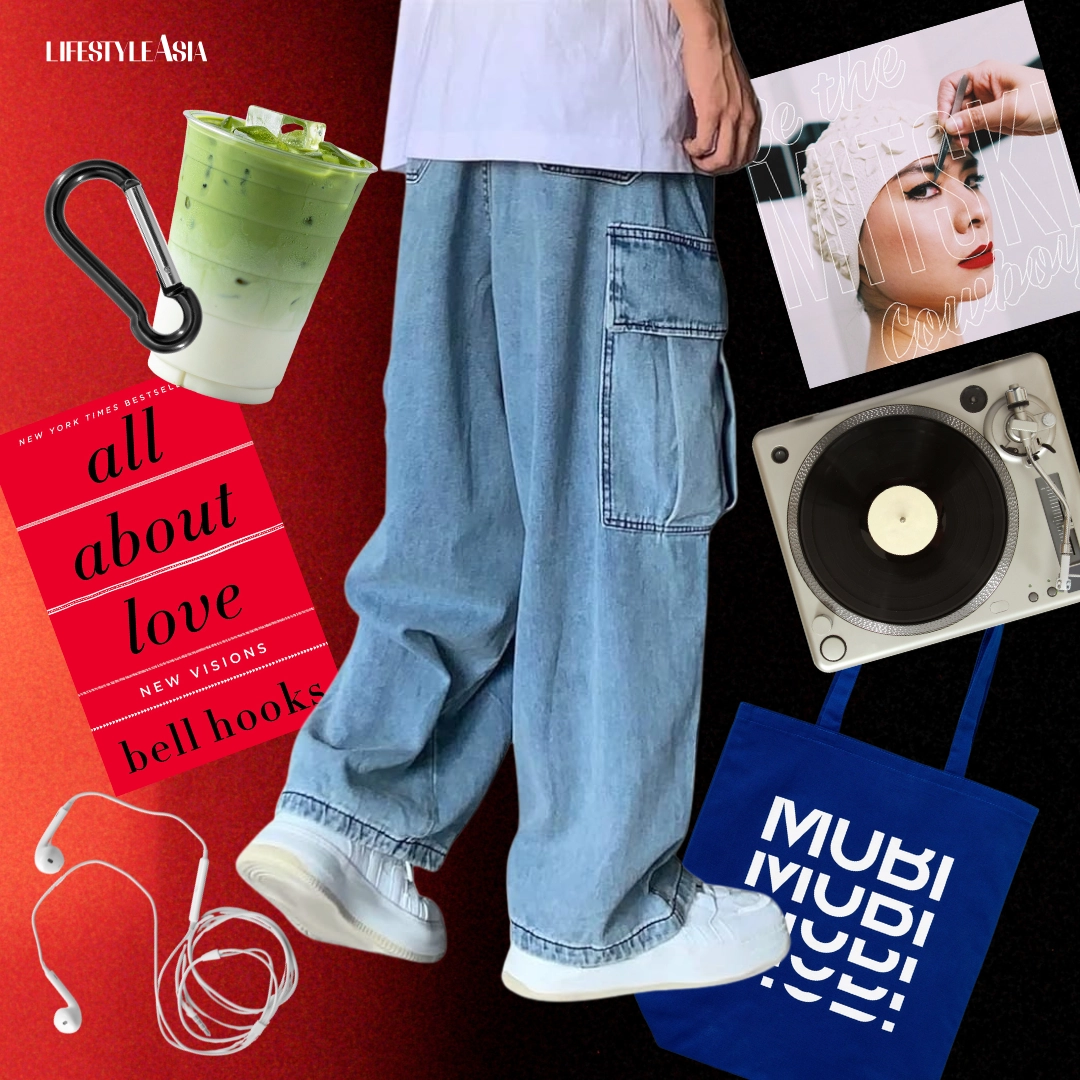
Tote bag in hand, feminist lit in tow; he’s not just playing the part, he’s directing the performance.
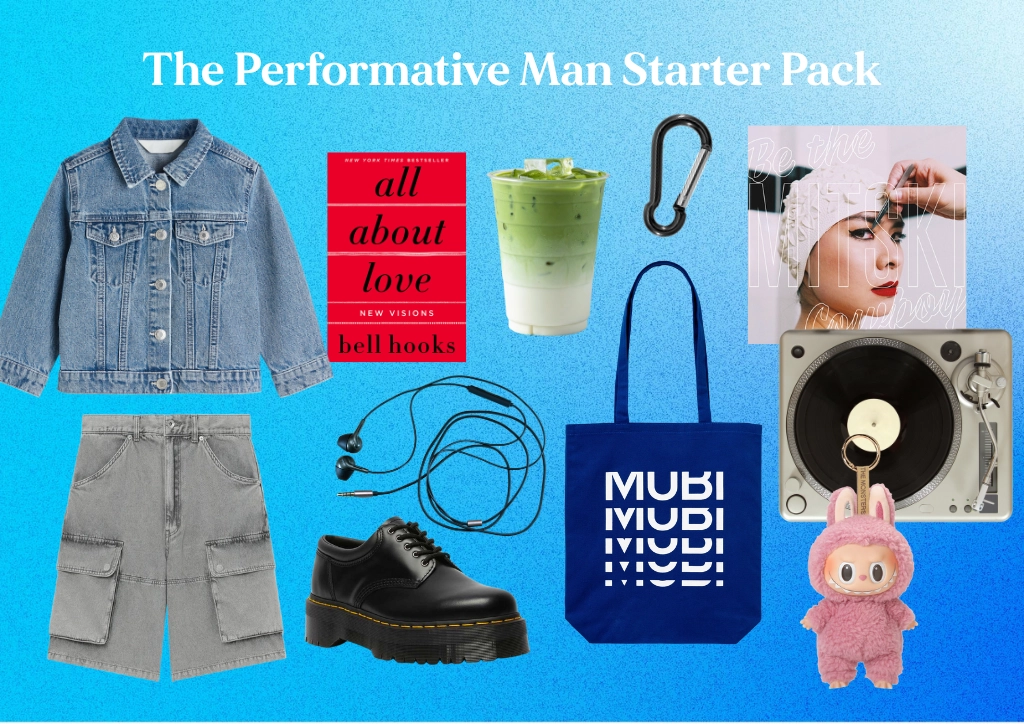
You’ve likely seen him on your feeds: that man dressed in oversized shirts and jackets, probably wearing cargo shorts and Doc Martens while sporting medium to long hair (bonus if he has microbangs). He’s never without his trusty tote bag featuring some fringe cultural reference, a cup of matcha (with oatmilk), wired headphones or earbuds, and the pièce de résistance: a book that’s niche enough to look cool and cultured (bonus if it’s feminist literature). What you’re witnessing is the performative man in his not-so-natural state—and the internet is eating it up, creating a feedback loop that blurs the distinction between irony and authenticity.
READ ALSO: The Cult Of Self-improvement: Cultural Totalitarianism, Capitalism, And Social Performance
Defining The Performer
While writing this feature, I was trying to find ways to define what netizens refer to as the “performative man/male.” I started thinking about what differentiates them from your average hipster and soft boy—and then I realized they’re a strange amalgamation of all these things, only more public.
Hipsters veer from the mainstream, but they don’t necessarily thrive off attention. The soft boy is a close relative of the performative man, perhaps a distant cousin, one that kickstarted the practice of challenging conventional standards of masculinity; but like hipsters, there doesn’t have to be a public element here.
Performative men are exactly what the name states: contrived personas built with a particular goal in mind. The goal? To get the ladies by showing that they get the ladies in the most blatant, visible ways possible.
Merriam-Webster and Oxford Dictionary will, understandably, fail to define this modern archetype, so we must make our own definitions. From what I’ve gathered, the performative man is a distinct flavor of “nice guy”: he’s in touch with his feminine side, and is into everything culturally informed, emotionally intuitive women are into—sometimes to the point of mimicking queer-coded femininity.
We seem to have swung to an extreme on the pendulum. A desperate (and necessary) cry to end toxic masculinity has pushed a certain brand of man into thinking that this is all he needs to curry favor. “Sensitive? Outspoken about women’s rights? I can do that,” he thinks. “I’ll do it so well, it becomes my entire personality. Irresistible.”
Add a craving for online validation into the mix, and you have a volatile combination that’s dubious, to say the least. Suddenly, being a decent person is made into a spectacle: values are used as masks, distilled into checklist items of desirability, rather than genuine authenticity.
Can You Spot The Performative Man?
The performative man will listen to Clairo, Mitski, and Laufey—hell, he may even pull up vinyls of these artists from his Shakespeare and Company or MUBI tote. He reads Bell Hooks’s All About Love or Sylvia Plath’s The Bell Jar in public transportation, cafés, or any space where people can see him learning all he can about women’s woes (he’s really out to end period cramps, guys—promise). Bonus, though a passing trend, he may even have a Labubu hanging off his tote (because men can love cute things too).
With him, there’s an air of forced casualness that screams “Hey, look at me! But also don’t look at me, because I don’t actually care what people think.” Reader, he very much cares about what you think—that’s the premise of his entire persona.
Oh, and if you think he’s a sweet guy who’s partner material, you’ve fallen for the magic trick. A certain level of emotional unavailability and immaturity—hidden beneath layers of composed and cultured appeal—is part of his entire schtick. That’s why the illusion exists: because there’s something to hide.
The Performance Of Performing
Social media has done a good job of distilling and caricaturing the performative man, solidifying his overall image in the collective consciousness. Take this viral reel on Instagram, which shows user @jordiemaa teaching his little sister how to reject the advances of performative men à la bootcamp training.
“Cafe hopping is for broke boys!” she screams into the camera. You have to admit, it’s pretty funny to see a girl as young as her being so cognizant of the milieu. While it’s played as a joke, women who’ve encountered performative men in the wild know the training will come in handy one day.
But the thing is, these men aren’t letting themselves become the butt of the jokes. They’re joining the chorus of laughter, leaning into the satire of their identities and embracing the very stereotypes people tease them for. The intention here is to create a sense of self-awareness, as if to say: “You can’t gain the upper hand, because I know I’m like this. I’m owning it.” Here, the act of performing—a constant in the online realm—becomes a part of the performance itself.
And it works, to a certain extent. People laugh (I certainly do), because there’s a sense of shared recognition. I see you. You see me. You know someone like this unironically exists. At some point, it becomes harder to tell whether a person is simply acting like a performative man to film content or actually is one. Alternatively, that may not even matter, because the persona itself is faux. The point is, you see them—and that’s exactly what they want you to do. Visibility is the brand, irony is the armor, and attention is always the endgame.
Frequently Asked Questions
The performative man is driven by a desire to project a “soft” and intellectually evolved persona that specifically caters to the modern female gaze.
Unlike previous trends that were earnest, the performative man uses self-awareness as a defensive shield by leaning into the memes and satire surrounding his look.
His wardrobe of oversized shirts and wide-leg trousers is intended to signal a relaxed, anti-corporate stance that prioritizes comfort and “artistic” depth.
The performative man is a modern evolution of the “nice guy” who replaces traditional chivalry with a checklist of “evolved” traits like emotional intuition and an interest in indie culture.
The trend is viewed as a fascinating byproduct of a digital age where the line between a sincere personality and a social media persona has become blurred.