
Pedestrian-centered urban pockets are slowly gaining ground in Manila, offering a glimpse of life beyond car-first planning; that said, optimal walkability is still a work in progress.
First, to get the central fact of this feature out of the way: Manila isn’t a walkable urban center. At least, not completely. We can point to counterexamples, and some of them do deserve merit—considerable parts of Makati, swathes of Bonifacio Global City (BGC), areas of Pasig, and farther down south, Aseana City, to an extent. But let’s be honest: these are central business districts (CBD), often propped up by private funding, not the result of robust government action or public infrastructure.
Of course, progress is still progress. This isn’t meant to be a piece ragging on what’s been done right, but one that points out the work that remains, not just in isolated pockets, but across an entire city. That will take time. That will take funding. That will take labor. It won’t happen overnight, but it’s worth acknowledging where things currently stand, because regardless of where we sit in society, we all share the need for better mobility—which is an indicator of a higher quality of life.
READ ALSO: The Vanishing Language Of Nature
Defining The Walkable City
So what makes a city “walkable,” and when do we start bestowing that title on an urban center? Beyond the crucial element of road safety, accessibility and mobility are just as essential. There’s no standardized set of criteria, but I’ll be using some key requirements presented by an independent policy think-tank, The Global Development Research Center (GDRC).
The organization defines walkability as “the degree to which an urban environment is pedestrian-friendly and supports walking as a mode of transportation. It emphasizes creating cities and neighborhoods that are designed and built with the needs and safety of pedestrians in mind, encouraging people to walk as a primary means of getting around.”
What its experts cite as an indicator of accessibility is that most essential amenities, services, and recreational facilities should be reachable within a “15-minute walk, bike ride, or public transit journey from one’s residence.” These include schools, grocery stores, healthcare facilities, parks, restaurants, commercial establishments, public transportation terminals, community centers, and places of employment.
The standards of “walkability” will, of course, differ from country to country and city to city. Yet, based on GDRC’s observations, many of the world’s most pedestrian-friendly cities (like Tokyo, Barcelona, and Copenhagen) share similar features.
These include: pedestrian infrastructure (proper sidewalks, crosswalks, intersections, bridges); compact and mixed land use (keeping residential, commercial, and recreational areas close together); connectivity (providing routes or paths that allow everyone to navigate their urban environment with ease); safety and comfort (well-lit streets, proper signage, consistent security and traffic implementation, visually appealing spaces); and public spaces (green areas, third spaces, plazas, streetscapes, and other places that encourage community-building).
A Picture Of Pedestrian Life In Manila
According to a report by the Asian Transport Observatory, the International Road Assessment Program (IRAP) —a charity that releases ratings on road safety infrastructure—states that only five percent of roads in the Philippines meet their standards for pedestrians.
As someone who frequently commutes via the Metro Rail Transit (MRT) and Light Rail Transit (LRT) systems, I do my fair share of walking. I actually love walking, but not in most parts of this city, and for a number of reasons. I’m sure the average commuter would agree there’s a lot to improve. Even if you don’t commute regularly, chances are you’ve had to walk more than intended, whether traffic was unbearable, a destination was nearby, or you simply didn’t have access to private transport that day.
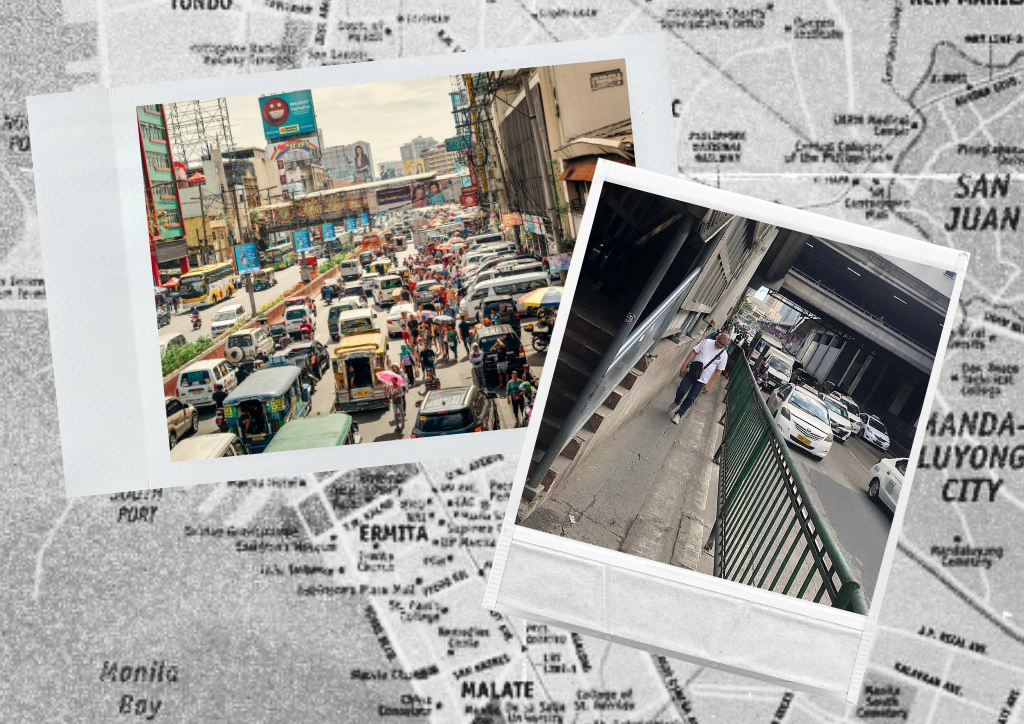
I’ve got some observations, many of which haven’t changed much in years. Sidewalks are nonexistent in many areas, and even when they do exist, they’re either too narrow or poorly maintained, falling apart more than our lives on the worst days. At times, the sidewalks themselves become hazards, with gaps and disrepair causing people to trip or pushing them farther out into the street. There’s also little to no cover to shield pedestrians from downpours or harsh sunlight, something you’d think would be a given in a tropical country.
Cars and motorcycles show little regard for pedestrian space, parking on and even driving through sidewalks and pathways, effectively cutting off any safe place to walk. Guardrails— those metal poles that might seem inconsequential but can actually help curb accidents by separating people from the wild, zipping cars on the road—are absent most of the time, or awkwardly positioned when they do appear.
Then there’s the lack of pedestrian crosswalks and footbridges, yet roads continue to expand, growing wider and closer to full-blown highways. Even in my small neighborhood in Quezon City, you really do feel like a chicken crossing the road, hoping vehicles will slow down just a little. Sadly, wide roads and a lack of proper traffic enforcement encourage them to keep going. Stoplights are strange, too: some give you ample time to cross, but many others don’t. To accommodate the sheer density of motor vehicles, they’re programmed to give pedestrians little to no realistic time to make it to the other side. Cars might be granted 100 seconds to move, while pedestrians are lucky to get anywhere between 20 to 40 (I’ve seen some go as low as 10).
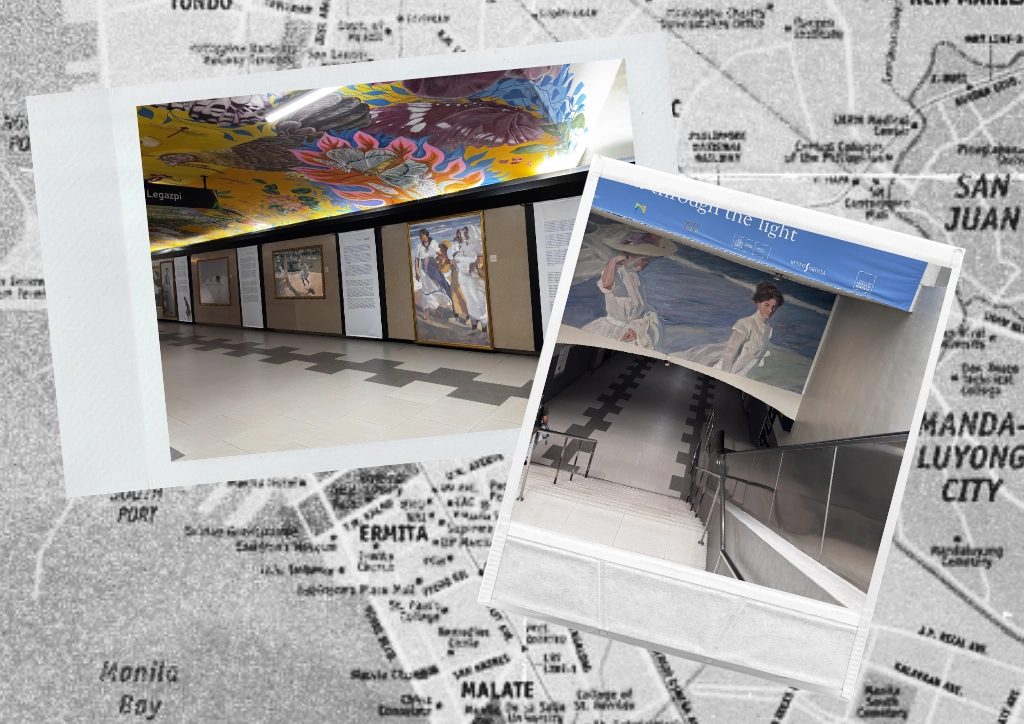
The structures meant to help people get from point A to point B, including those connected to public transportation, feel just as hostile. Stairs are steep and never-ending, with hardly any landings for people to catch their breath. I’ve seen older folks struggling halfway up the stairways leading to MRT and LRT stations, stopping not out of choice, but necessity.
A lot of essential services aren’t placed close together or fail to be reachable through walking alone, usually requiring transportation. Again, certain CBD areas are faring better. Makati is, to my mind, chief among them, with its tree-lined streets, shaded underpasses, clearer signage, and more generous, well-maintained sidewalks. But not every part of Makati looks like this, which limits how far you can really go while retaining a sense of ease. Its underpasses still pose problems, with few ramps and elevators for wheelchairs or people with disabilities, effectively preventing them from using the stairs. BGC is making progress too, though it could use more trees and shaded areas—especially during the sweltering daytime heat, when the sun bounces relentlessly off all the concrete.
A Car-Centric Society
In a study examining the walking environment in Manila, researcher Iderlina Mateo-Babiano cites a report from the Asian Development Bank on the situation, which pretty much matches the scenes above: “Manila’s poor pedestrian infrastructure has forced people to patronize other transport modes, such as paratransits (e.g. jeepneys) or motorized cars, even for trips that could have been otherwise easily accomplished by a 15 minute walk (approximately 1.2 km).”
Chicken and egg. Pedestrians, tired of being neglected, eventually work their way into owning and driving cars. Unfortunately, many drivers don’t pause to consider “the walkers” once they’re behind the wheel—not everyone, but enough to matter. Pair that with poor infrastructure, and you’re left with, once again, a hostile environment that makes people wonder if being on your feet is really worth it.

Ironically, only 12% of the Metro Manila population actually own a car, according to research on the “car-mageddon” situation in the area by Gina Gatarin and Aireen Andal. Yet, in a sardonic twist, 80 to 90% of our road networks are “allocated to car-centric mobility.” It doesn’t quite make sense, but there’s enough global research on Manila’s car-centric environment and horrible traffic to suggest that it’s not normal or ideal.
It doesn’t help that government initiatives have misdirected their efforts, insisting that simply building more car-centric infrastructure will somehow better road safety and efficiency—when we know the problems hindering development require more nuanced, thorough solutions, which JC Punongbayan—an assistant professor at the University of the Philippines School of Economics—comprehensively details in a feature for Fulcrum.
The statistics are morbid, but necessary in shaking us awake. Data from the Department of Health (DOH) states that at least 57,000 pedestrians in the country have been hit by vehicles in the span of 2005 to 2015. The numbers haven’t gotten any better in recent years.
The Benefits Of Cultivating A Walkable City
What does a truly walkable Metro Manila give you, then, based on everything we’ve touched on? Quite a lot.
For starters, it helps you get around faster—or at least at a normal, comfortable pace. Returning to the 15-minute standard: a well-designed city lets you reach everything you need without fearing for your life or safety, or expending excessive time and resources. I can believe this. Traffic in Manila gets so bad, I’ve found myself reaching relatively distant destinations faster on foot. But again, because of a lack of proper infrastructure, the journey itself is seldom optimal, and at times, riskier than I’d prefer.
Secondly, it’s just better for your body. A walkable city is, generally, a healthier one. As research by Eve Lu for the Scientific American reveals, moving to a walkable city can add about 1,100 steps to your daily count per day. That’s a significant figure, especially in a country where health problems relating to obesity are rampant, a lack of movement or activity being a leading driver.

Walkable cities also encourage more economic activity, as accessibility can lead to better foot traffic (quite literally). In turn, connection, equity, and social inclusion also improve as people explore their communities in ways they wouldn’t be able to by simply driving past places.
Then, the more obvious reason why better walkability is critical, which is environmental health. It’s not a be-all-end-all solution to our country’s pressing ecological problems, but the less people rely on fossil fuels, the less carbon emissions and air pollution. Sure, we’ve got electric vehicles, but not enough to really make a drastic change.
Perhaps the issue of a walkable city feels distant, or not especially urgent, if you have the resources not to think about it. But the truth is that everyone relies on these structures, whether they realize it or not. You may be young and able-bodied now, but that will change with time. Your car might need repairs one day, or you might not be able to book a cab. If walkability suddenly matters in those moments, then it has always mattered.
Frequently Asked Questions
Metro Manila is not comprehensively walkable. While areas such as Makati’s CBD and Bonifacio Global City have made progress in pedestrian infrastructure, these are largely privately funded enclaves rather than city-wide achievements. The International Road Assessment Program rates only five percent of Philippine roads as meeting pedestrian safety standards.
Walkability refers to how well an urban environment supports walking as a primary mode of transportation. The Global Development Research Center defines it as a design approach that ensures most essential amenities — schools, healthcare, grocery stores, parks, and public transport — are reachable within a 15-minute walk, bike ride, or transit journey from a resident’s home.
Despite only 12 percent of the Metro Manila population owning a car, research by Gina Gatarin and Aireen Andal estimates that 80 to 90 percent of road networks are allocated to car-centric mobility. Poor pedestrian infrastructure has pushed residents toward motorized transport even for short distances, a dynamic the Asian Development Bank links to Manila’s neglect of pedestrian needs over decades.
Key issues include nonexistent or poorly maintained sidewalks, a lack of pedestrian crosswalks and footbridges on widening roads, inadequate crossing time at traffic signals, vehicles encroaching on pedestrian space, minimal shade or cover from weather, and inaccessible public transport structures for persons with disabilities. Data from the Department of Health recorded at least 57,000 pedestrians struck by vehicles between 2005 and 2015.
A more walkable Metro Manila would improve daily commute efficiency, reduce reliance on fossil fuels, encourage economic activity through increased foot traffic, and support public health — research cited in Scientific American found that moving to a walkable city adds approximately 1,100 steps to a person’s daily count. Improved walkability also strengthens social inclusion and community connection across income levels.