When did being earnest and enthusiastic become a source of cringe?
When Vogue released its viral article “Is Having a Boyfriend Embarrassing Now?” by writer Chanté Joseph, the online sphere exploded with affirming responses that validated her arguments about public perception and men-centered womanhood. The word “now” is used to indicate not a past or possibility, but a very current state of affairs: women avoiding the visibility, and by extension vulnerability, of publicly claiming romantic attachment to male partners, largely within a cisgender, heterosexual context. But something didn’t sit right with me. It took some months of mulling over the piece to finally figure out what the problem was—not the article itself, but rather, a result of what we can refer to as The Age of Nonchalance (sorry, Edith Wharton, not very inventive of me).
READ ALSO: How Effort Has Become The New Luxury
Don’t Embarrass Me
I, too, am a woman who understands the grocery list of reasons these sentiments exist. As Joseph illustrates through a range of anecdotes, women are resisting the impulse to anchor their identities in being someone’s “girlfriend.” Public displays of romantic attachment—especially overt celebrations of boyfriends—are now often perceived as cringe-worthy, boastful, or tone-deaf in an increasingly abysmal dating landscape, or even detrimental to maintaining an image of “coolness” and independence.
This anxiety and jaded frustration have made their way into pop culture as well, Sabrina Carpenter capturing it in “Please, Please, Please”: “Heartbreak is one thing, my ego’s another/I beg you, don’t embarrass me, motherf**ker.”

Almost every woman has heard, or lived through, horror stories of men meeting the bare minimum and calling it a day. Of disappointing dates stacked end to end, or appalling behavior that reinforces how thoroughly girls are raised to orient their lives around a male-centered world. What bothers me isn’t the validity of these women’s perspectives and experiences, but the air of suffocating self-consciousness surrounding them, one that breeds shame-fueled repression and encourages constant self-monitoring in the name of “acceptability.”
The Happiness Police
These reactions are shaped by a culture that scrutinizes visible joy and treats earnestness as something to be corrected. If women are flinching at the prospect of public attachment, it’s because someone is always watching. Most of the responses in Joseph’s piece implicate a “they”: a viewership of either followers or friends whose opinions have an impact on what a woman shows or doesn’t show. Viewed through sociologist Erving Goffman’s theory of the “Dramaturgical Self,” in which the world is a stage and we’re performers adjusting our behavior to everyday interactions, this tendency makes sense.
“Even partnered women will lament men and heterosexuality—partly in solidarity with other women, but also because it is now fundamentally uncool to be a boyfriend-girl,” Joseph explains. “It’s not just in these women’s imaginations—audiences are icked out by seeing too much boyfriend content, myself included, it seems (as indicated by my liberal use of the mute button).”
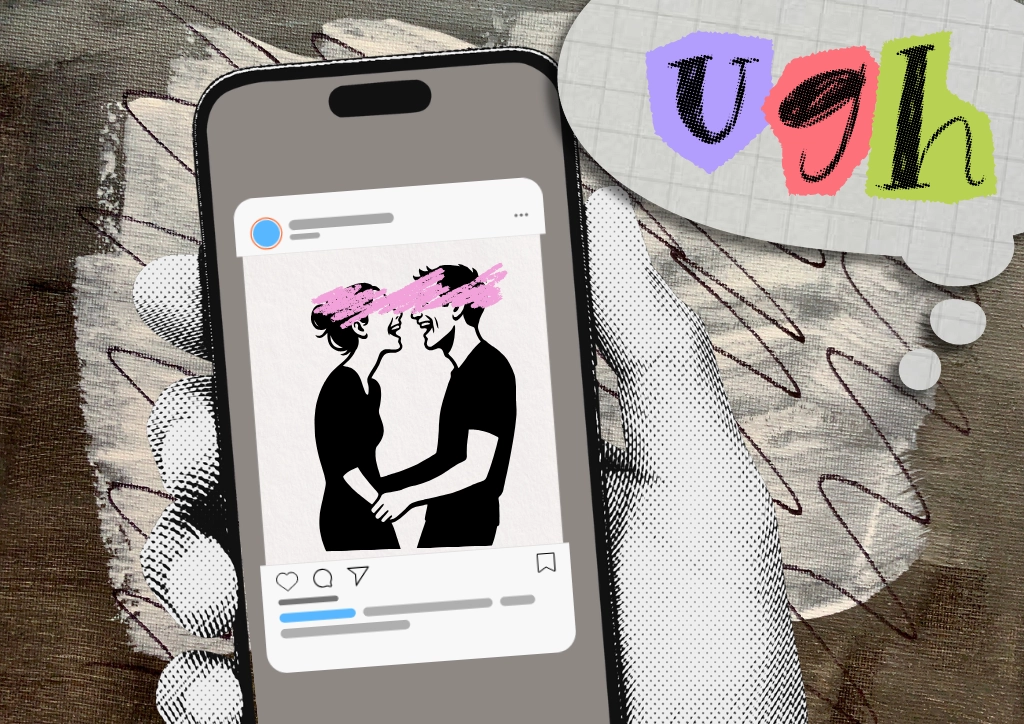
But who, exactly, gets to decide what’s “fundamentally uncool”? And why are audiences (a word I use reluctantly, as if our lives have been reduced to someTruman-esque reality show) so quick to feel “icked” by other people’s enthusiasm? Why would you choose to surround yourself with people who judge you for the very things that make you happy?
Of course, there’s nothing wrong with being genuinely private. But if you want to shout your love from the rooftops, by all means. No one has the right to shame you out of that expression. Shouldn’t friends, at the very least, be happy for you, regardless of their opinions and current circumstances? I’ve seen people go through long stretches of dating disappointment and still manage to feel sincere joy when someone they love enters a healthy, wonderful relationship.
Yes, maybe you know that one friend who talks endlessly about their partner. Maybe it’s irritating because they dominate the conversation, make it their entire personality, or forget to ask about your life altogether. But that’s a matter of courtesy and character, and it hardly warrants a culture-wide impulse to shame or silence visible attachment. We’ve reached a point where it feels more natural to police other people’s joy than to celebrate it.
Caring About Not Caring
This normalized nonchalance extends far beyond the cisgender, heterosexual female experience Joseph writes about. In today’s ever-online climate, we’re made to believe the public is entitled to weigh in on how we show our care. The “solution,” then, is withdrawal: to hide rather than express, to leave things unsaid or ambiguous instead of enthusiastic and open, because who knows what humiliation or pain might await beyond the safety of one’s shell. “Not caring” (or feigning to) has become our most socially acceptable armor, offering protection against vulnerability and the mortifying ordeal of being perceived.
This nonchalance moves from public to private behavior, affecting the very ways we approach our personal relationships. Psychologist Mark Travers breaks it down in his Forbes feature “2 Ways The ‘Nonchalance Epidemic’ Is Killing Love,” describing the cultural moment as one “where emotional detachment is seen as desirable.”
“Often, people send texts without being too emotionally involved, leave others on ‘read’ and ghost them when things seem like ‘too much effort,’” he writes. “Many singles are scared to seem too interested. But this chronic nonchalance, where no one wants to make the first move or admit they care, can quietly sabotage our chances at loving relationships.”
Anxieties are understandable, even inevitable. But as Travers notes, playing it safe by “pretending that nothing affects you” often does more harm than good, either pushing people away or preventing meaningful connection altogether. Yes, hurt always waits somewhere on the horizon, but isn’t that just part and parcel of existence? Bottling up emotion and performing detachment in the name of safety is about as logical as never stepping outside for fear you might trip and fall.
Worse yet, should “trends” dictate the ways you view your partner, regardless of who they are? We’ve reduced people and connections to objects: fashionable or out of style, trophy or major embarrassment. It harkens back to petty, cliquish high school logic: we can hang out, but I just can’t be seen hanging out with you. If it’s so humiliating to be associated with your partner, then why, pray tell, are you in a relationship with them at all?
Ironically, we still care “too much,” even when we insist we don’t. The difference is that our concern is no longer centered on ourselves or our relationships, but on the mirror through which they’re reflected to us by others. Both nonchalance and the opposite “chalance” are exhausting, true. The question is which one ultimately offers the greater sense of fulfillment—and risk, but again, c’est la vie. I’ll choose sincerity every time, even when it costs the illusion of acceptability. Maybe it’s time to make unabashed caring cool again. And even if it isn’t, that’s fine. Take a page from The Age of Nonchalance’s book: who cares?