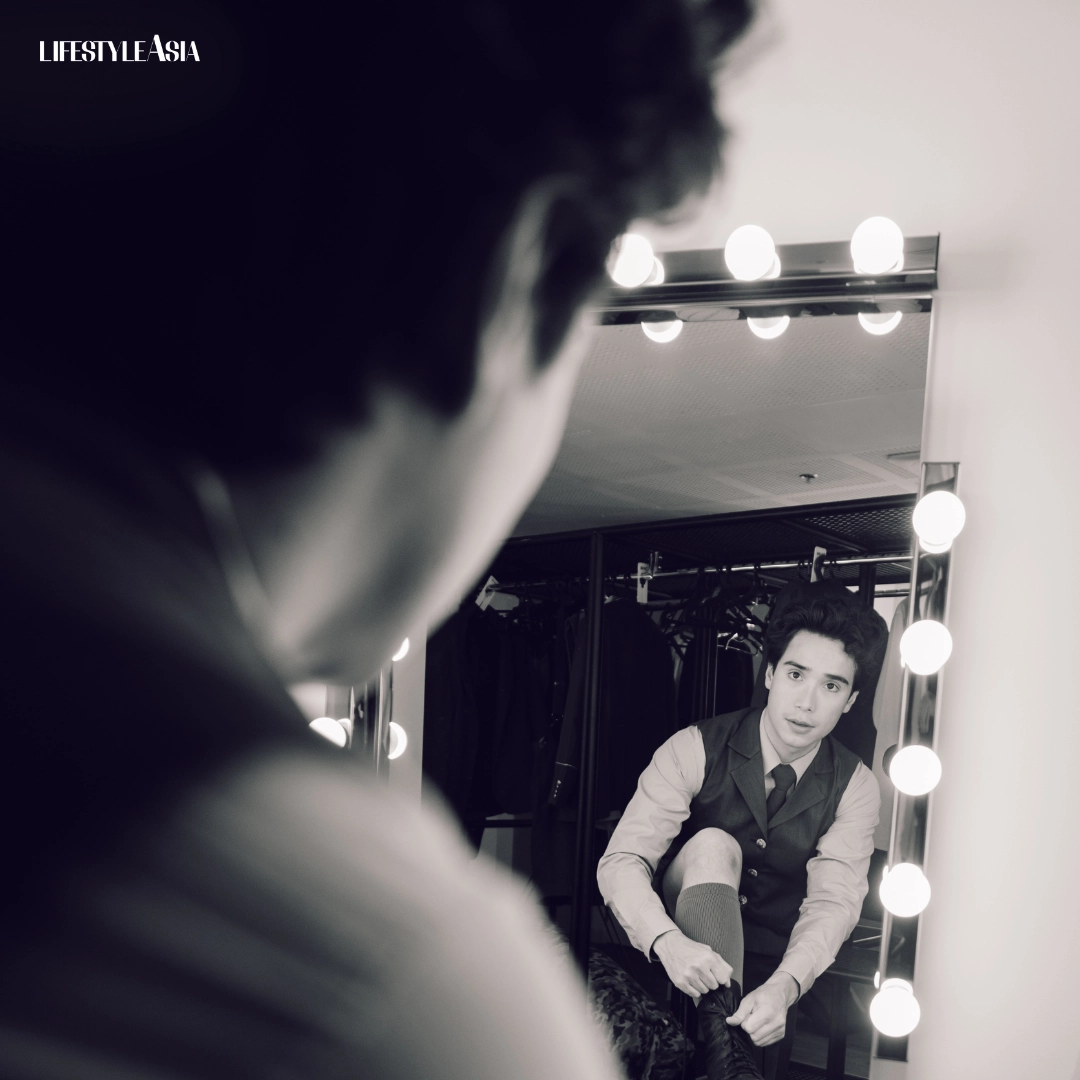
We sit down with the stage actor as he makes his Philippine theater comeback in The Sandbox Collective’s production of Spring Awakening.
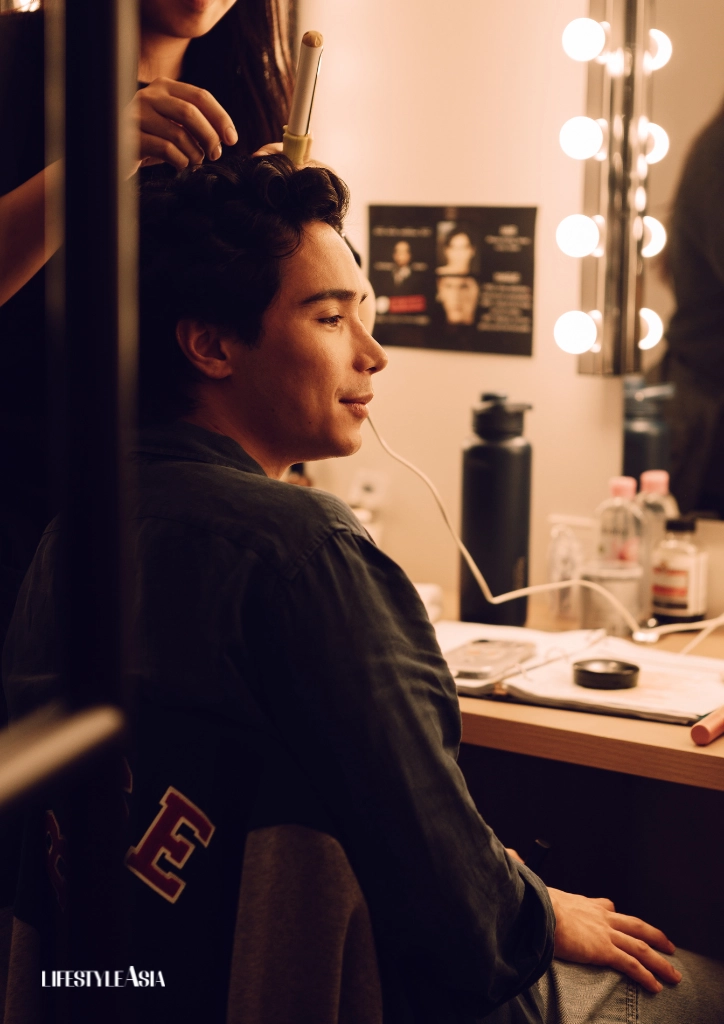
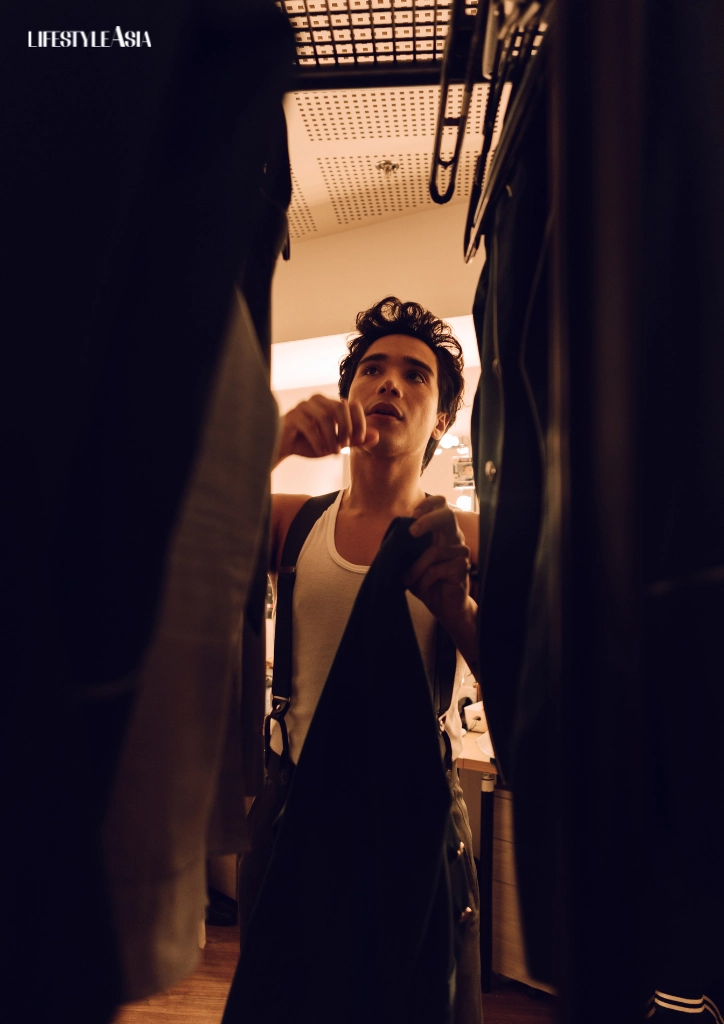
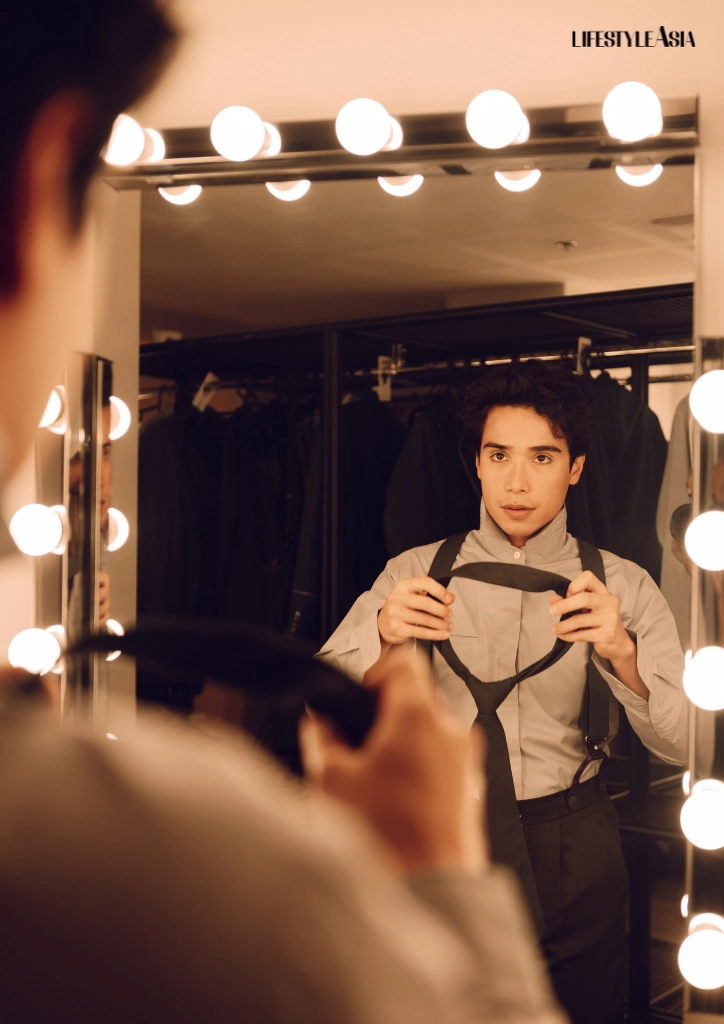
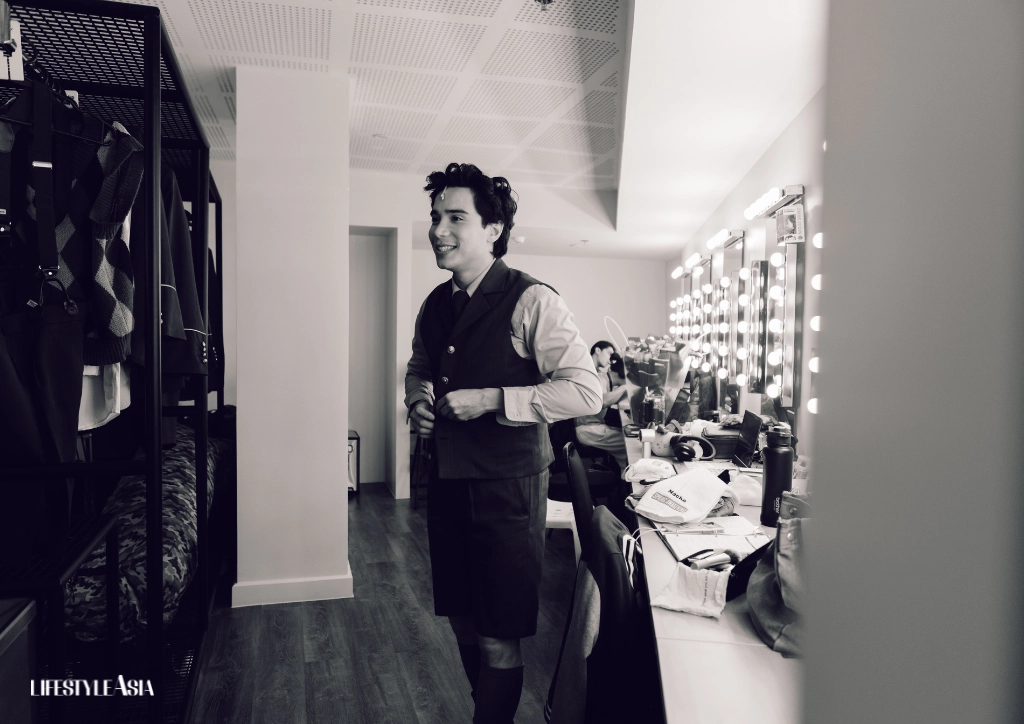
As our team watches Nacho Tambunting get ready for the gala night of Spring Awakening, a highly-anticipated production staged by The Sandbox Collective, I can’t help but think there’s a parallel to draw between the act of dressing up and performance. Even more so in this case: the actor is well aware of our presence, his movements candid yet coordinated for his “early” audience. He laughs generously, rifling through clothes, taking out pieces, putting them on with care, moving with nonchalant grace rather than self-conscious tentativeness. He’s, in the most physical sense, getting into character, layer by layer.
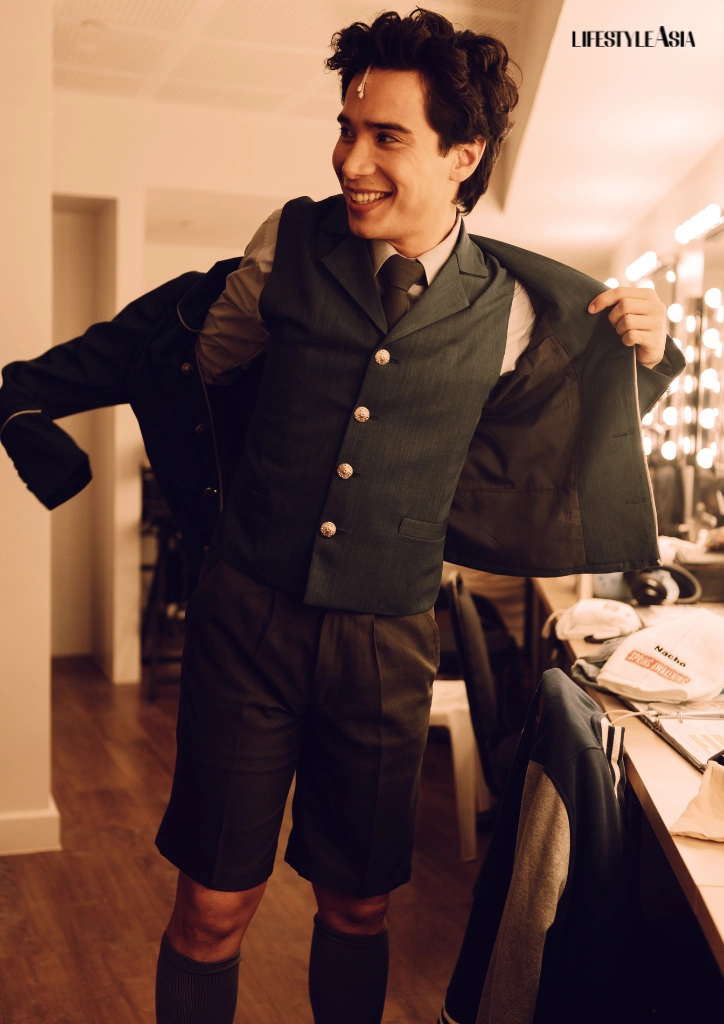
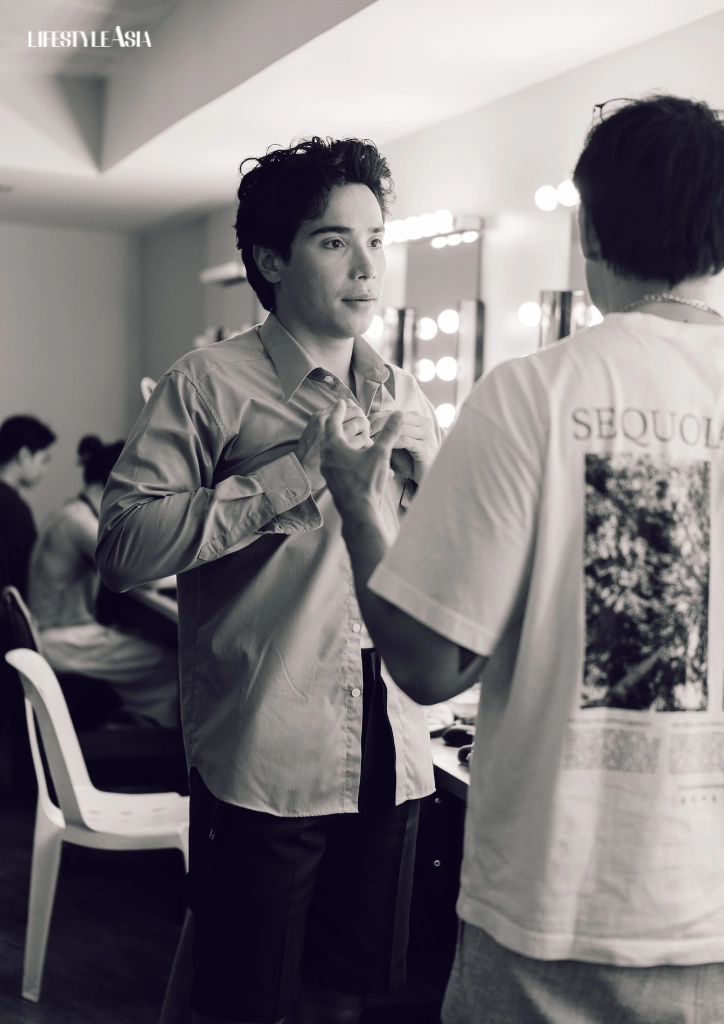
While the performer remains distinctly separate from any role he plays, there are fragments of his Melchior that catch the light, passing through expressions that shift between contemplative and playful, serious and joyous, cerebrally sharp yet courteous. One moment, he’s showing us a monogrammed towel with glee, a token for every member of the cast; the next, he’s listening raptly to new stage directions from his alternate, Alex Diaz. People contain multitudes. In the case of performers, the ease with which they tap into them is both a gift and a skill, honed over time to appear effortless.
As for time, well, Nacho has had plenty of that, thus far—20 years in the industry, to be exact, 2026 being the tail end of these two decades. That’s more than half the years he’s been on this earth, which speaks volumes about what the profession is to him: lifeblood. Acting is, in many ways, a vocation. A calling that chooses you as much as you choose it.
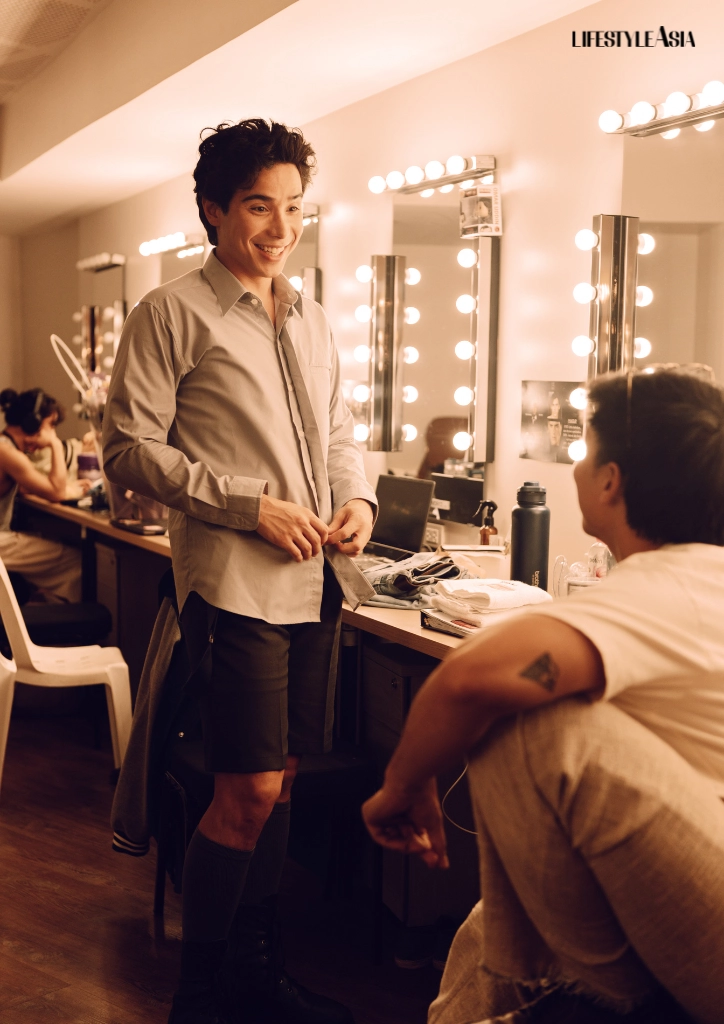
“You do it because you love it,” Nacho tells me, nodding fervently when I utter the statement. “You need to do it. There’s something about it you just can’t get elsewhere.” People who’ve heard various iterations of this sentiment, phrased by creatives across all professions, might find it overused, perhaps even saccharine. But the actor doesn’t glorify or romanticize. A wry smile spreads across his face, his eyes glinting with a knowing light as he shares a quote from the novel Audition by Michael Shurtleff.
“To go into acting is like asking for admission to an insane asylum. Anyone may apply, but only the certifiably insane are admitted,” he says, chuckling. In the same vein, it takes a special kind of grit, shaped by that exact breed of madness, to stay—and stay he does. After living and working in New York for over a decade to pursue a professional acting career, Nacho makes his much-awaited comeback in the place where it all began: Philippine theater. Lifestyle Asia maps this bildungsroman in an exclusive interview, one of an actor finding his place in the world, even when being a performer is anything but easy.
READ ALSO: Hear The People Sing: The Cast Of Les Misérables Paint Their Own Portraits
A Boy And The Sound Of Music
There wasn’t a specific catalyst that pushed Nacho to pursue acting; it was a seedling that simply sprouted from the ground one day, ready to become more. While he credits his mother, Claudia Wilson-Tambunting, for having immersed him in the arts at a young age, taking him to shows both within and outside the country, the urge to perform was innate from the beginning.
“I always loved to perform. I would stand on a baol [a traditional wooden chest] or a table, and I would sing little songs, or do a little dance, and my mother always encouraged it,” he shares.
As a child, Nacho was, let’s call it “artistically precocious,” possessing an indelible commitment that transforms art appreciator into creator, spectator into actor. With a laugh, he adds, “You can ask any friend or cousin. They would come to my house, and I would make everyone do a play. I would direct it, create the costumes, and have people do the lights. I would get so frustrated when no one was taking it seriously!”
Nacho certainly took it seriously enough to begin a lifetime calling, playing the role of young Kurt von Trapp in Repertory Philippines’ 2006 production of The Sound of Music—his very first show outside the confines of his childhood make-believe stage. He’d go on to star in various productions staged by what was then a small yet highly respected group of theater companies. These titles included The Producers, Alice in Wonderland, Jack and the Beanstalk, Peter Pan, Seussical, and Camp Rock. (Here, he played Nate Grey, the character of Nick Jonas. This is where I insert a funny anecdote about how throngs of girls in my batch developed the biggest crush on him when we watched the Repertory Philippines production in grade school, so much so that one of my friends even messaged me, jogging my memory of the phenomenon after seeing a behind-the-scenes photo I posted of this shoot. Clearly, he succeeded in being the heartthrob the show needed him to be.)
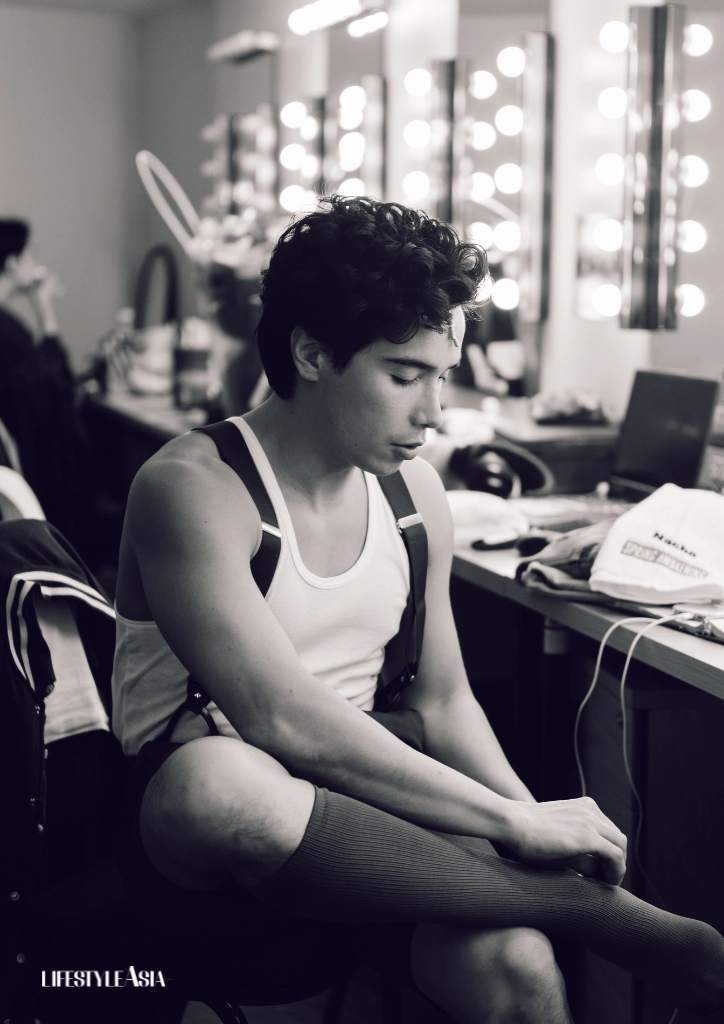
Yet even with his multi-disciplinary training, Nacho considers himself an actor first and foremost. It’s not just a matter of preference, but an acknowledgement of a craft’s endurance. “Sure, I can sing, I can dance, but I look at both of those as a means for storytelling, as a means for acting,” he explains. “Not to say that I’m at this stage at all, but there will come a point where you can’t dance anymore, or your singing is not as strong, but you can act ‘til the day you die, given that your mind is still lucid. You can read a script, memorize lines. It’s something I’ll take with me until my last breath.”
It’s a vow that carries weight, but one that feels familiar and crucial to anyone committed to a creative practice. In an industry that demands vulnerability, staunch commitment, nerves of steel, and thick skin, it’s both compass and life raft, something to cling to when the waters turn rough—storms that Nacho has weathered more than his fair share of.
Waking Up In A City That Never Sleeps
New York was the turning point. In a typical bildungsroman structure, we can see the city—an incubator of creative talent and the birthplace of some of the world’s most renowned theatrical works—as the inciting incident that transforms a young man into a seasoned performer.
After graduating high school in the Philippines, Nacho pursued his studies at New York University, where he graduated with honors and a degree in Theatre from the Tisch School of the Arts. The talent he already possessed was polished; it was fed the structures, skills, and theoretical foundations needed to build a solid bedrock, from breaking down a script to understanding performing arts history.
He continued his career in theater while taking on screen roles in shows like NBC’s Rise, Apple TV+’s Dickinson, and Netflix’s The Expanding Universe of Ashley Garcia. His film credits include the 2023 rom-com Asian Persuasion (directed by Tony Award-winner Jhett Tolentino), and the upcoming indie film Come into my Arms, in which he plays a century-old ghost accidentally summoned by a disillusioned Filipino-American woman, the two eventually falling in love.
As it goes, it wasn’t all sunshine and rainbows. Rejection and blunt feedback are inevitabilities in the creative world, and in the performing arts, one faces them viscerally through countless auditions and rehearsals. It’s the weight actors bear to do the things they love, and do them well.
“New York is a totally different animal. If Manila is a small pond, New York is the giant ocean. You’re swimming with the big fish, and you’re thrown straight into the deep end. It can be very intimidating,” Nacho states. “Early on, when I had some success, there was a lot of imposter syndrome, sort of not being sure if I really deserved to be there.”

He pauses, his face pensive. “New York is no joke,” he says. “I don’t think some people really understand how competitive and cutthroat it is. How you just have to walk through each rejection as if it’s nothing. One of my acting teachers in school, Randy Graff, once said to me: ‘You walk into that audition room with nothing to prove, only to share.’ I think that’s something that we, as performers and as people, continue to work on as we go through life. It’s not always going to be perfect. It’s a continuous work in progress, and that’s part of the excitement of it.”
During his time in New York, Nacho picked up a new set of professional standards that he’d carry with him on his return to Manila.
“You really are rubbing elbows and getting to collaborate with people who are at the top of their game. It’s very efficient; there’s a structure to things. With the unions, they have certain rules in place about how rehearsal processes are supposed to be,” he explains. “So it really dropped me into an industry that’s, in many ways, fully realized and fully commercial—that’s something the Philippines is building towards.”
Nacho Tambunting Comes Home
A lot can change in a decade. Nacho was delighted to see how much bigger the landscape of Philippine theater had become during his time abroad. “There are apparently 15 different theater companies that put on shows. When I left, there were only Repertory Philippines, Atlantis Theatrical, and PETA. We’ve even developed a sort of off-Broadway scene where you can watch readings of plays or things that are not as fully commercialized. I think that’s where new work and the voice of Filipino theater can really find itself.”
The rhythms of theater life in Manila are still undergoing an evolution—something Nacho had to re-acclimatize himself with after New York’s more fast-paced environment—but he looks forward to what’s to come. “Compared to the last time I was here, I’ve seen certain advancements, and it’s a sign of a growing industry. I hope I can contribute, in some ways, to its growth.”
One of the aforementioned new theater companies is The Sandbox Collective, whose fantastic production of the ever-relevant coming-of-age rock musical Spring Awakening marks Nacho’s return to the Manila stage.
In many ways, this homecoming feels like a full-circle moment for the actor, as the company’s team is filled with familiar faces who practically saw him grow up, including Menchu Lauchengco-Yulo and Audie Gemora, both of whom played Maria von Trapp and Captain von Trapp, respectively, to his Kurt von Trapp all those years ago in his first official stage appearance.

“Even Jojo Amboy, our stage manager. After one of our runs, one day, he came up to me and said: ‘Nacho, I’m so proud of you, my baby.’ For him to pull me aside, give me a hug, and say that…it almost brought me to tears,” Nacho reflects. “It reminds me why I do what I do. It’s about the community, about the people. To be able to go abroad, brush up on my skills, really study my craft and hone it, and come back to share it with the community means a lot.”
A Spring Awakening
Though it features a young cast of characters, Spring Awakening isn’t a lighthearted play, even if it has its moments of levity. It presents us with adolescents in 19th-century Germany discovering the changes that puberty brings—“spring” as an awakening, both sexual and spiritual in nature. In a conservative society like theirs, curiosity and exploration are met with condemnation, deemed too taboo.
Melchior Gabor is one of the musical’s pivotal players: an intelligent young man longing to break free from the shackles of his society, knowledgeable about everything from philosophy to the human body, yet reckless and unaware of the dangers that come with an unchecked pursuit of liberating pleasure.

It’s not Nacho’s first time encountering the text, as he played the role of supporting character Georg Zirschnitz in NBC’s Rise, which depicted students staging the musical. Yet taking on the role of Melchior required its own kind of mindset.
“He really is the lead of the show, and is the only character that has a full arc from beginning to end, because the other characters don’t quite fully realize their dreams,” he expounds. “It was about separating what I already knew about the text and trying to come into it with fresh eyes. Now being much older than when I previously performed it, there’s more life experience there. More to pull from. I’m seeing the scenes and lines in a different light.”
To get into character, Nacho begins immersing himself in the musical as early as its beginnings, listening to the opening act (“Mama Who Bore Me”) from the theater’s wings to get himself into the zone.
“I try to quiet my mind, because I tend to think a lot, and I want to be present and respond to my scene partner,” he shares. “I take it beat by beat. I focus on the first moment: how I come into the scene feeling a certain way, then I allow the different things in that scene to affect me, carrying me to the point I need to be at the end of that scene, then carrying that feeling into the next one, and so on. It’s about tracking a kind of progression to show the full arc of the character.”
This intuitive, instinctive approach reflects Nacho’s preoccupation with the novel. “I enjoy watching actors who make interesting choices,” he explains. “I don’t necessarily enjoy things that feel cliché or sort of boring. I want to watch an actor do something unexpected. There’s something about performance in its most raw form. When you remove all the frills, the intimacy of shared humanity is what really shines through. And when an actor or performance can captivate me that way, it speaks to my soul. That’s what keeps me in this business.”
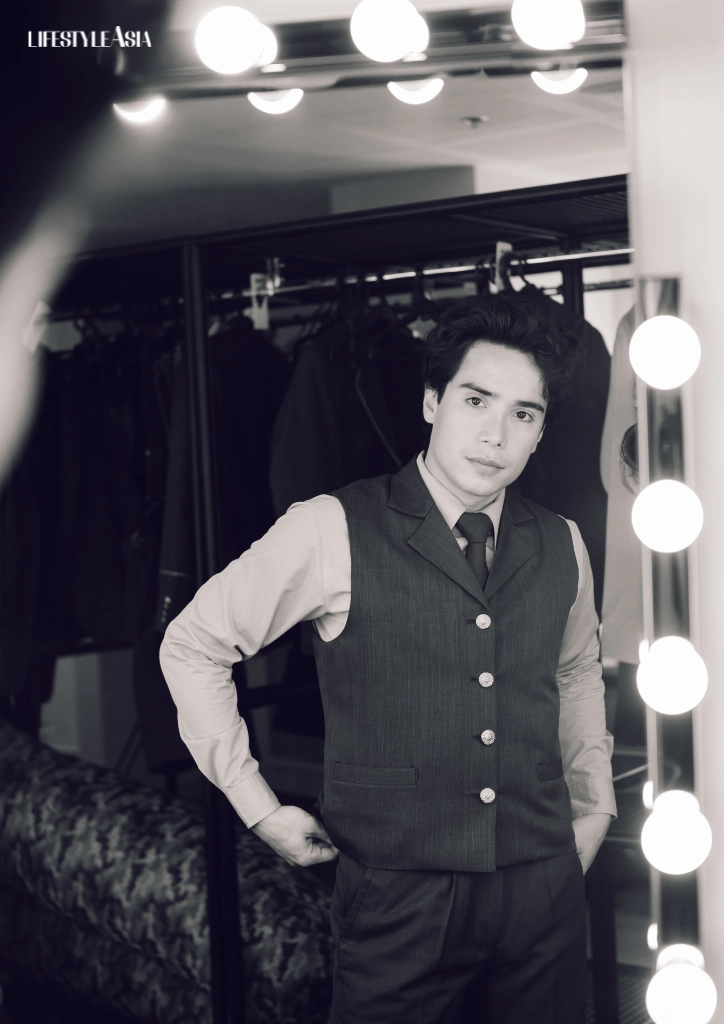
Of course, if there’s the act of getting into character, there’s also the matter of getting out of it, once the curtains fall. Day in and day out, Nacho and his fellow cast members throw themselves into the hazy, frantic world of suffocating sexual repression, teen pregnancy, societal pressures, physical abuse, and suicide—so it only makes sense that they need ways to delineate what’s happening onstage and off-stage.
“You do spend a lot of time in a vulnerable place. Your body doesn’t necessarily identify that this isn’t real. Your mind knows you’re pretending, but your body doesn’t know,” he points out. “So during rehearsals, I would change my clothes to send small signals to myself. I’d come in with my own clothes, put on another outfit for rehearsal, then change and do something else afterwards. Showering helps too, feeling fresh again, and getting into bed. It’s just reminding myself that what we experienced was pretend, because it’s a lot to do every night.”
And On He Goes
What’s next for Nacho Tambunting? It might be too early to jump ahead, seeing as he’s still, at the time of this writing, in the thick of Spring Awakening’s more-than-one-month run. But the actor keeps himself busy: in a few months, he’ll be flying back to New York to participate in (and help produce) a staged workshop of Mercury Makes the Skin Glow, a work-in-progress play by Filipino-American playwright Gaven Trinidad about the culture that informs Filipino beauty standards, hot on the heels of its warmly received developmental reading held here in Manila.
Learning hasn’t stopped, even after decades in the industry. Nacho continues to take classes, eager to better himself. “It’s important to practice—like going to the gym. I take weekly acting classes at Bob Krakower’s studio [an acting teacher at The Juilliard School in New York], which is wonderful. It’s a very small class, and our coach is really great. A lot of my classmates are also working actors, so it’s a nice cohort of people who are sort of at a similar point in their career, at a similar level.”
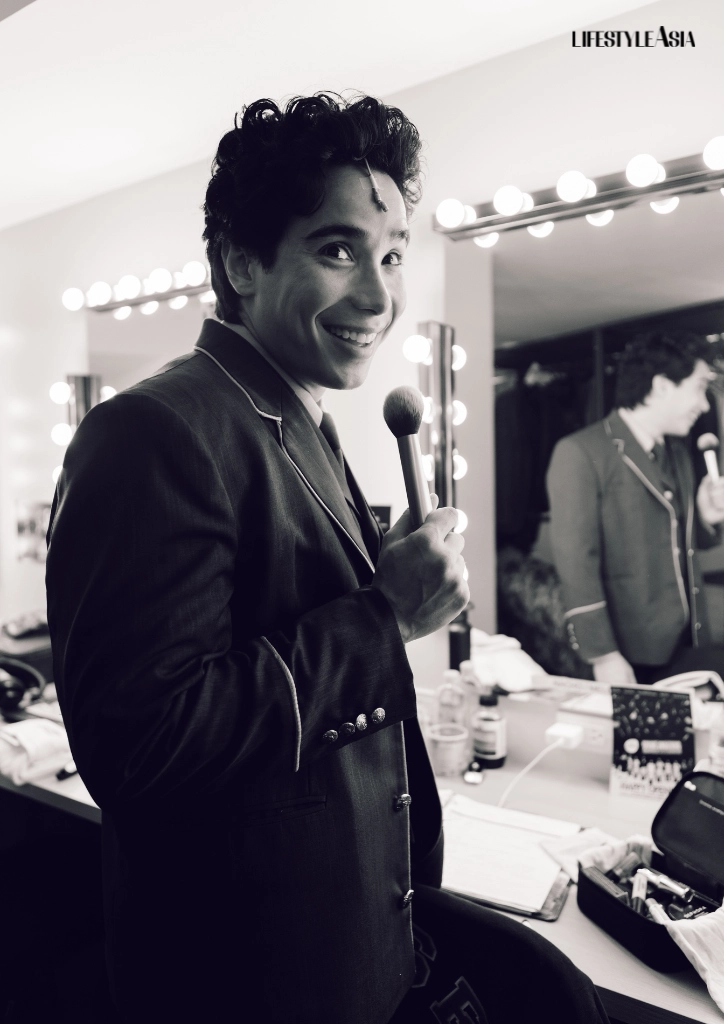
If we’re to follow Roland Barthes’ literary theory, “The Death of the Author,” we can’t really mix up an actor with his character, or an artist with their work. They draw inspiration from life, but their creations stand on their own, separate from lived experience, once they reach the audience. Yet I do see, as I first stated in this feature, the most admirable parts of Melchior in Nacho.
In the musical, the actor plays a kind of Icarus, his thirst for knowledge and freedom leading to a steep, downward tumble as he flies too close to the sun. Outside of it, however, his constant search for knowledge is a form of liberation—a road of development that carries him higher in a craft he has devoted himself to.
“On I go, to wonder and to learning/Name the stars and know their dark returning/I’m calling to know the world’s true yearning/The hunger that a child feels for everything they’re shown,” Nacho sings in the darkness of Rockwell’s Proscenium Theater during the gala night. “You watch me, just watch me.” And we can’t help but do exactly that.
Photography by Excel Panlaque of KLIQ, Inc.
Shot on location at The Proscenium Theater, Rockwell
Special thanks to The Sandbox Collective and The Proscenium Theater