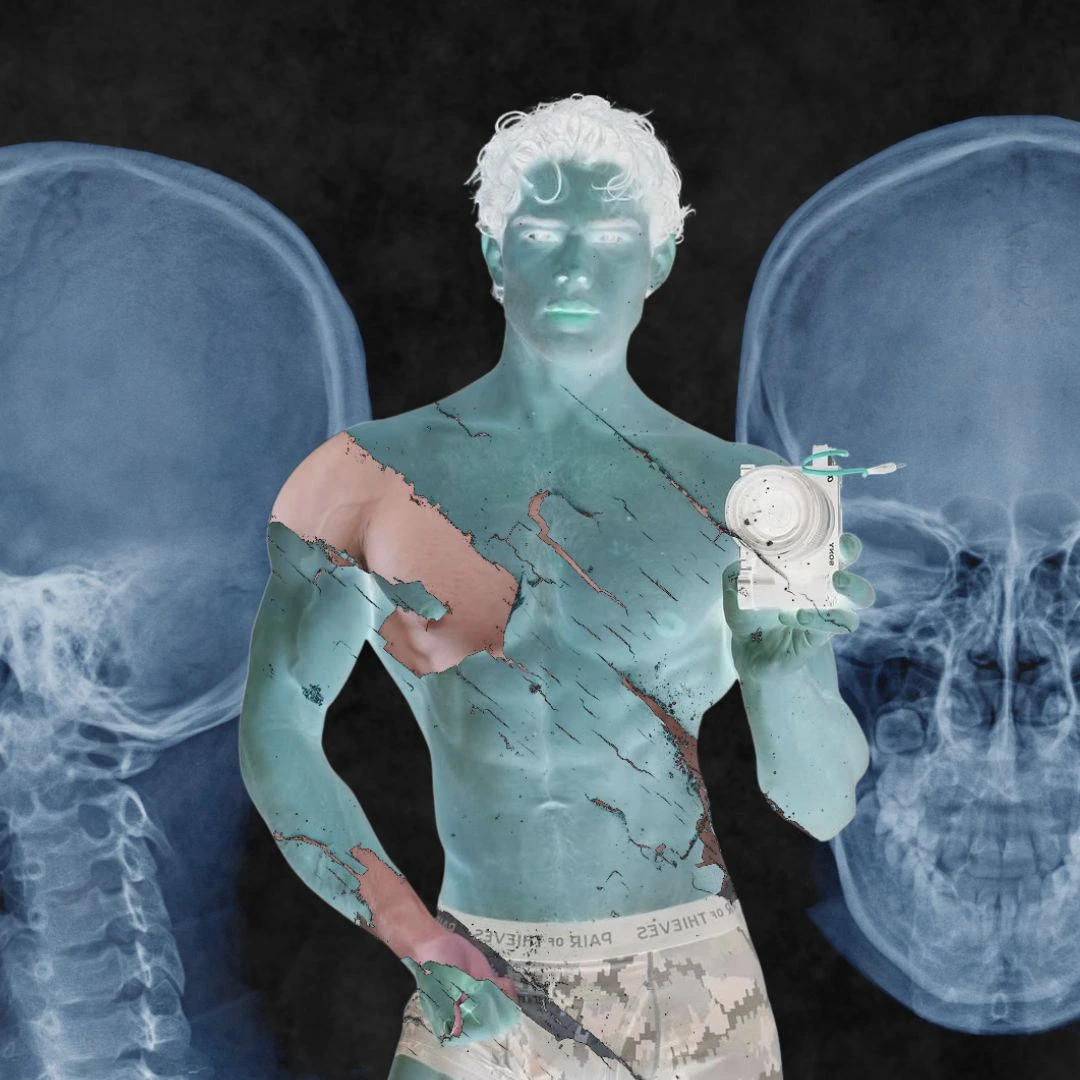
Looksmaxxing is part skincare, part forensic facial analysis, and a whole lot of weird. Here’s why your FYP is obsessed with your “canthal tilt.”
If you’ve been anywhere near the algorithm lately, you’ve probably encountered a teenager staring into the camera, acting as if it owes him money, lightly pointing at his jaw, and announcing that his “positive canthal tilt” is the only thing separating him from a life of invisibility. Welcome to the world of looksmaxxing.
It’s not exactly a hobby anymore: for some people, it’s closer to a personality framework. It’s part gym routine, part skincare obsession, part late-night forensic analysis of one’s own face under a kind of bathroom lighting that should honestly be illegal. And, depending on who you ask, it was either pioneered or accelerated by a mysterious figure known only as Clavicular: a user of fitness myth and internet folklore deemed responsible for convincing a generation that collarbones and hollow cheeks are a lifestyle.
READ ALSO: Bebot: How A Filipino Beauty Trend Made A Global Comeback
Looksmaxxing: What Is It, Actually?
At its simplest, looksmaxxing is the act of “maximizing” your attractiveness through grooming, fitness, styling, and, if you go far enough down the forum threads, a concerning number of pseudoscientific facial theories that sound like they were invented at 3 AM by someone holding a ring light. It’s like glow-up cultureCultureshared traditions, beliefs, values, customs, arts, and social practices that define the identity and way of life of a community, society, or nation.Go to Culture Glossary, but enveloped in ultra-masculine energy, fewer vibes, and way too many diagrams of skulls.
Most people in the space split it into two camps. There’s softmaxxing, which is the more “socially acceptable” version of looksmaxxing. You go to the gym. You fix your skin. You get a haircut that doesn’t look like you lost a bet. You learn that clothes should fit your shoulders.
Hardmaxxing, on the other hand, is the deep end. This is where things get uberly intense. We’re talking cosmetic procedures, fillers, and the kind of “face optimization” advice you should absolutely not take from a Discord server with an anime character as its avatar. The extreme “harmaxxers” would even undergo “bone smashing,” a dangerous act done by smashing their faces with hard objects in an attempt to reshape their facial bone structure.
And somewhere in the corner, there’s “meth maxxing.” It involves the use of methamphetamine (crystal meth) to rapidly lose weight, stay awake, and achieve a “lean” or “shredded” physique, often promoted under the guise of hyper-masculine self-improvement.
Looksmaxxing can be seen as a product of the infamous Male Loneliness Epidemic, disguised as a skincare routine. In an attempt to solve a grocery list of internal problems, guys are turning to external “optimization.”
Why Looksmaxxing Started
It didn’t happen overnight. It built up slowly, almost without anyone noticing. Growing up with front-facing cameras means you end up seeing your own face more than any generation before you ever did. That kind of constant self-view can really change how you relate to yourself: everything starts to feel like a game. The body becomes a set of stats you can tweak and compare. Jawline gets read as strength, skin as defense, hairline as luck. You’re no longer just existing with your face—you’re evaluating it.
There’s also the appeal of control. When everything outside feels uncertain—the economy, future, and general direction of the world—it makes sense that people latch onto what feels measurable. Your face becomes one of the few things you can track, adjust, and “improve.” Clavicular sits within this narrative, his philosophy tied to the idea that the body can be treated like a long-term project, carefully managed down to the cheekbones.
The Sad Truth Behind The Trend
nHere’s the thing: there’s nothing wrong with wanting to look better. Taking care of yourself, dressing well, feeling confident in your skin are all normal human behavior. But looksmaxxing has a way of turning mirror into data. At some point, you stop seeing a face and start seeing “asymmetry issues.” That’s usually when the hobby stops being fun and starts feeling like unpaid labor. For what it’s worth, no amount of jawline analysis will save you if your personality gives “wet paper towel in a group chat.” Where you draw the line is actually pretty simple: improve yourself, sure, but just don’t turn your reflection into a full-time job with performance reviews, complete with a regiment that ultimately does more harm than good.
Frequently Asked Questions
Looksmaxxing is an online subculture focused entirely on maximizing physical attractiveness through routines that range from standard styling and fitness to dangerous, unverified facial alterations.
Softmaxxing involves non-invasive self-improvement like fitness, skincare, and styling, whereas hardmaxxing encompasses risky, invasive procedures such as plastic surgeries, fillers, or dangerous structural bone smashing.
Clavicular is an internet personality and streamer recognized within online fitness folklore for popularizing extreme aesthetic standards, including prominent collarbones and hollow facial structures.
Algorithmic exposure via front-facing cameras and social media feeds compels adolescents to view their faces as customizable data sets during times of broader socioeconomic uncertainty.
Continuous facial analysis often exacerbates body dysmorphia, replacing healthy self-care with obsessive evaluation, performance anxiety, and a hyper-fixation on minor physical asymmetries or perceived flaws.