Coming out is often portrayed as a single life-changing moment, but for many queer people, it’s a lifelong process shaped by identity, safety, and circumstance.
“I’m gay.” It’s a short sentence, but often one of the hardest to say. Once spoken, it can feel like a weight has finally been lifted. For many queer people, one of the most defining moments of their lives is coming out: revealing a truth that has long existed, even when it remained unspoken. It’s the act of telling others that, for you, love has often felt like something you had to fight for, rather than a given, in more ways than one. Coming out of the closet is more than a personal declaration; it’s an act of courage, vulnerability, and self-acceptance in a world that hasn’t always made space for queer identities. But while coming out is often celebrated as a milestone, not everyone is able—or willing—to step outside the closet. Today, we open the door and explore the many realities of queer life: the joy and freedom of coming out, and the complicated, deeply personal reasons some choose to stay in the closet.
READ ALSO: The Queer Nostalgia Of 90skabaklaan And Why It Resonates Across Generations
Why Coming Out Is A Continuous Spectrum, Not A Destination
Pop cultureCultureshared traditions, beliefs, values, customs, arts, and social practices that define the identity and way of life of a community, society, or nation.Go to Culture Glossary has taught us to imagine coming out as a singular, grand moment. Someone sits their parents down and delivers a carefully rehearsed speech; tears are shed, and by the end of the scene, they’re officially out. Roll credits.
Reality is far less tidy. In an article for the Journal of Homosexuality entitled “The Invisible Work of Closeting,” researchers Kirsti Malterud and Mari Bjorkman describe the metaphorical closet as a “Revolving Closet Door” rather than a sealed room. The image feels accurate because coming out is rarely a one-time event. It’s a process that follows queer people into new jobs, new friendships, new cities, doctors’ appointments, family gatherings, and even casual conversations with strangers. For many, the closet isn’t a place they leave behind, but rather, something they move in and out of depending on the room they walk into.
There’s an exhausting amount of invisible labor involved in navigating this reality. Malterud and Bjorkman call it the “invisible work” of closeting: the constant calculations, edits, and assessments that happen before a sentence even leaves your mouth. For members of the queer community, this might involve asking questions like “Do I correct the assumption that I’ll be entering a heterosexual relationship?” or “Do I explain myself, or do I let it slide?”
Meanwhile, in the Journal of Mental Health, researchers Patrick Corrigan and Alicia Matthews write about the “secrecy cycle”: the psychological burden created by concealing a stigmatized identity. The secret itself becomes work. It demands vigilance. It occupies mental space and follows you around; coming out doesn’t automatically erase that burden, either. Malterud and Bjorkman’s research found that disclosure can move a person from being socially invisible to intensely “luminous,” meaning suddenly visible, scrutinized, and set apart from the heterosexual norm. The closet may be exhausting, but visibility carries its own weight.
This is why the idea of being “fully out” can be misleading. According to Kate Klein and colleagues in the article “Complicating the Coming Out Narrative” for the Journal of Homosexuality, queer youth consistently described coming out as dynamic, ongoing, and non-linear. Some participants spoke about repeatedly explaining themselves because they didn’t fit stereotypes associated with their identities. Others found themselves disclosing information each time their understanding of themselves evolved.
That’s the truth rarely reflected in popular narratives. Coming out isn’t a destination you arrive at, but a series of decisions made across a lifetime, shaped by context, safety, and circumstance. Some days, the closet door swings open. Other days it closes halfway. Most people spend their lives somewhere in between.
The Fluidity, Labels, And Community Pressure Faced By The Queer Community
The traditional coming-out story follows a familiar script. You were one thing, then you discover who you really are. Then, you tell the world. Simple. Except sexuality rarely behaves that way. In her analysis of coming-out narratives, researcher Margaretta Jolly critiques what she calls the “conversion narrative”—the assumption that people move neatly from a false heterosexual identity to an authentic queer one. It’s a neat and compelling story structure, but it leaves little room for uncertainty, contradiction, or change.
Human desire is often messier than that. For bisexual, pansexual, queer, and sexually fluid individuals, identity can often feel like an ongoing conversation. There may not be a dramatic revelation or even be a definitive answer; sometimes there’s only a gradual understanding that shifts over time.

The problem is that it’s human nature to seek some kind of certainty. So many queer people find themselves repeatedly explaining identities that others perceive as temporary, confused, or incomplete. Research by Klein and colleagues found that participants frequently expressed frustration over having to come out again and again—not only because identities evolved, but because others struggled to understand experiences outside rigid categories. It helps to note that the pressure doesn’t always come from heterosexual spaces. Communities formed around acceptance can sometimes become invested in certainty as well, usually through labels.
But queer lives have never fit neatly into boxes. Not every story follows a straight line, and not every person arrives at a single, permanent label. For some, coming out is a declaration, and for others, it’s a question; for many, it’s both. So what’s the most “honest” coming-out story? It might just be the one that leaves room for change.
An Option, Not A Requirement
When conversations about coming out happen in the media, they’re often framed as a rite of passage, something every queer person must eventually do to live authentically. I understand where that idea comes from, but I also know how fortunate I am that my own story unfolded differently.
My mom actually knew I wasn’t straight for quite some time—call it that unspoken motherly intuition. My dad, however, only pieced it together after a family trip we took to Japan. A friend of mine had a sudden slip-up, casually calling me “sister” right in front of him. It was a tiny, funny moment, but it was enough to get the gears turning in his head.
Which brings me to Christmas night in 2017. The party had started winding down. Relatives were scattered around the house, some still eating, some already preparing to leave. At some point, my dad pulled me aside. I don’t remember every detail of that conversation. I remember the feeling more than the words. What I do remember clearly is him looking at me and saying, “Anak, tanggap kita” [My child, I accept you], and the tears I shed hearing those words. I cried not because of the accumulated exhaustion from having to reveal something or spending hours rehearsing a speech, but because I was preparing myself for rejection. I cried because, before I could even find the right words, he knew what to say and reach out first.

In an article for Journal of Marriage and Family, researcher Diane D. van Bergen and colleagues found that many parents already suspect (or even know) their child’s sexuality long before a formal coming-out conversation takes place. In some cases, parents are the ones who initiate the discussion. Reading this years after my own experience, it’s all strangely familiar.
My parents gave me something many queer people never receive: the privilege of not having to make a terrifying choice. That privilege isn’t universal. For every story like mine, there are stories of young people being kicked out of their homes, cut off financially, rejected by their families, or forced to choose between their safety and their honesty. Research consistently shows that decisions around disclosure are shaped by factors such as family support, financial dependence, race, geography, and community acceptance.
That’s why I’m uncomfortable with turning the act of coming out into an obligation. It should never be touted as some moral requirement, measure of courage, or test of how proud you are, which leads me to my next point.
Why Staying In The Closet Is Still A Valid Decision
For some people, coming out brings freedom. For others, staying private is what keeps them safe, and that safety matters. Researcher Mary Gray’s work with rural queer youth illustrates this beautifully. Many young people carefully balance visibility with survival, weighing their identities against family ties, community belonging, and practical realities. In these contexts, public disclosure isn’t always the most liberating choice, and in some cases, it’s the most dangerous one.
The queer community often celebrates visibility, and rightly so. Visibility has changed laws, transformed cultureCultureshared traditions, beliefs, values, customs, arts, and social practices that define the identity and way of life of a community, society, or nation.Go to Culture Glossary, and helped countless people feel less alone. But visibility should always be a choice. At the end of the day, being queer isn’t proven or “activated” upon disclosure. It’s not validated by a speech, a social media post, or a dramatic announcement; the simple fact is that you don’t owe anyone a coming-out story. If you’re lucky enough to have people who meet you halfway—who tell you, before you even find the words, that you’re loved exactly as you are. Make sure to hold on to them, because that’s really all you need to live an authentic life on your terms.
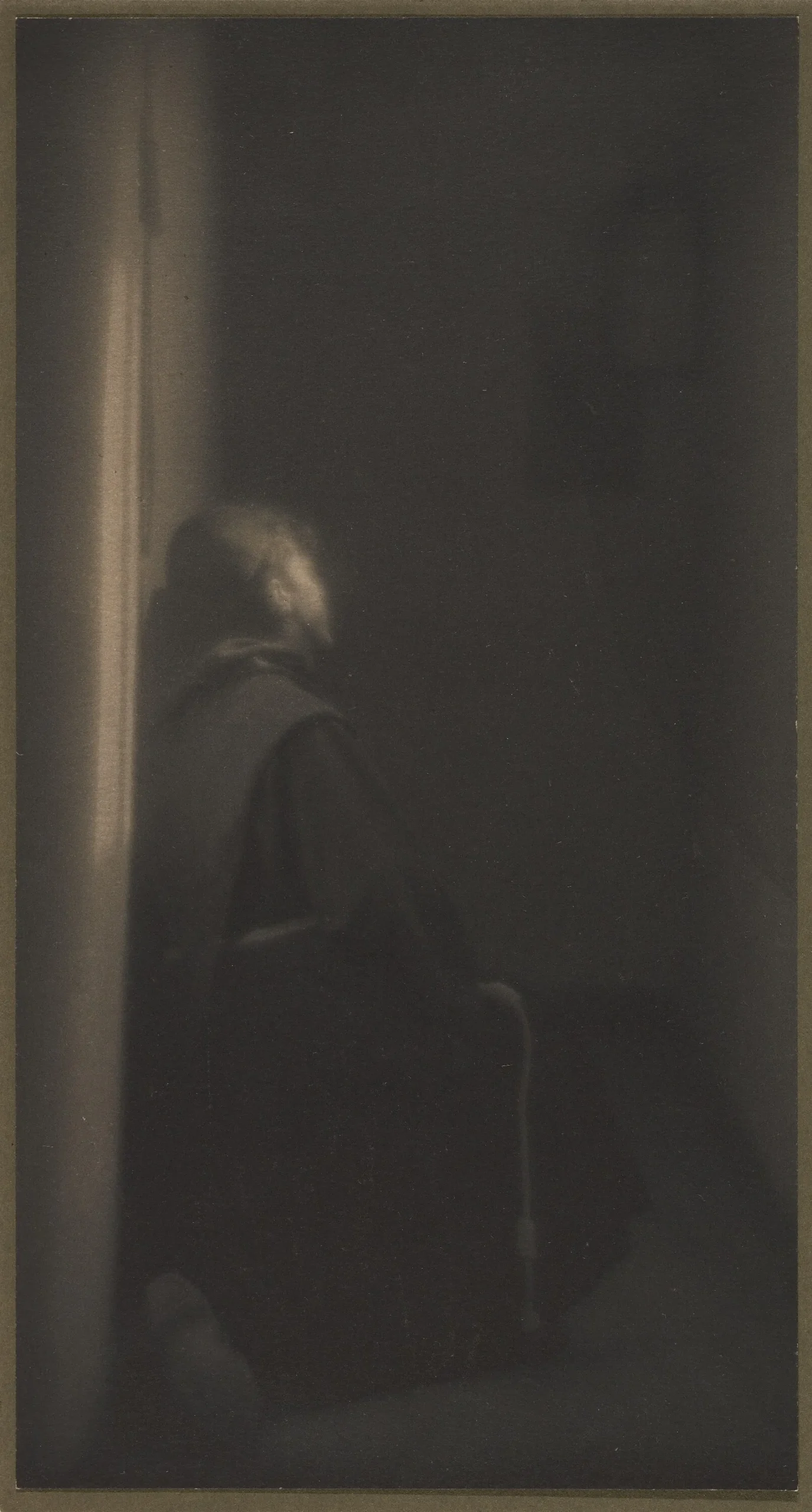
Banner image features “[Kneeling Monk at Prayer] / Vita Mystica” (1900-05) by F. Holland Day, courtesy of the Getty Museum
Frequently Asked Questions
Not usually. Many LGBTQ+ people describe coming out as an ongoing process that happens across different stages of life, relationships, workplaces, and social environments.
No. A person’s identity is valid regardless of whether they choose to disclose it publicly. Safety, family dynamics, financial independence, and personal comfort all influence the decision to come out.
People may remain closeted to protect their safety, relationships, housing, employment, or emotional well-being. For some, privacy is not about shame—it is about survival, security, or personal choice.