Through her colorful, textured works that play with space and perspective, artist Bea Batungbacal distills quotidian moments into compositions that reframe and defy time’s ephemerality.
In the first chapter of his seminal book Ways of Seeing, art critic and novelist John Berger opens with a discussion on the ways we perceive the world around us, particularly in the act of artistic creation and viewership. “The way we see things is affected by what we know or what we believe,” he begins. “To look is an act of choice. As a result of this act, what we see is brought within our reach—though not necessarily within arm’s reach. […] We never look at just one thing; we are always looking at the relation between things and ourselves.” In many ways, this is the thesis to the recent solo exhibition of artist Bea Batungbacal at June Eatery, aptly titled from where i sit.
READ ALSO: Une Chambre À Soi: Inside The Creative Sanctuary Of Kim Cruz
The Perception Of Memory in from where i sit
Curated by Ayni Nuyda, the exhibition offers windows of perspective: paintings of various destinations Batungbacal has visited as an avid traveler, as well as quotidian spaces that nevertheless provide a unique sense of place. It’s the world through an artist’s eyes, and while every work of art is ultimately a product of subjective experience, there are those artists who possess a gift for translating their idiosyncrasies into captivating focal points within their works—Batungbacal being one of them.
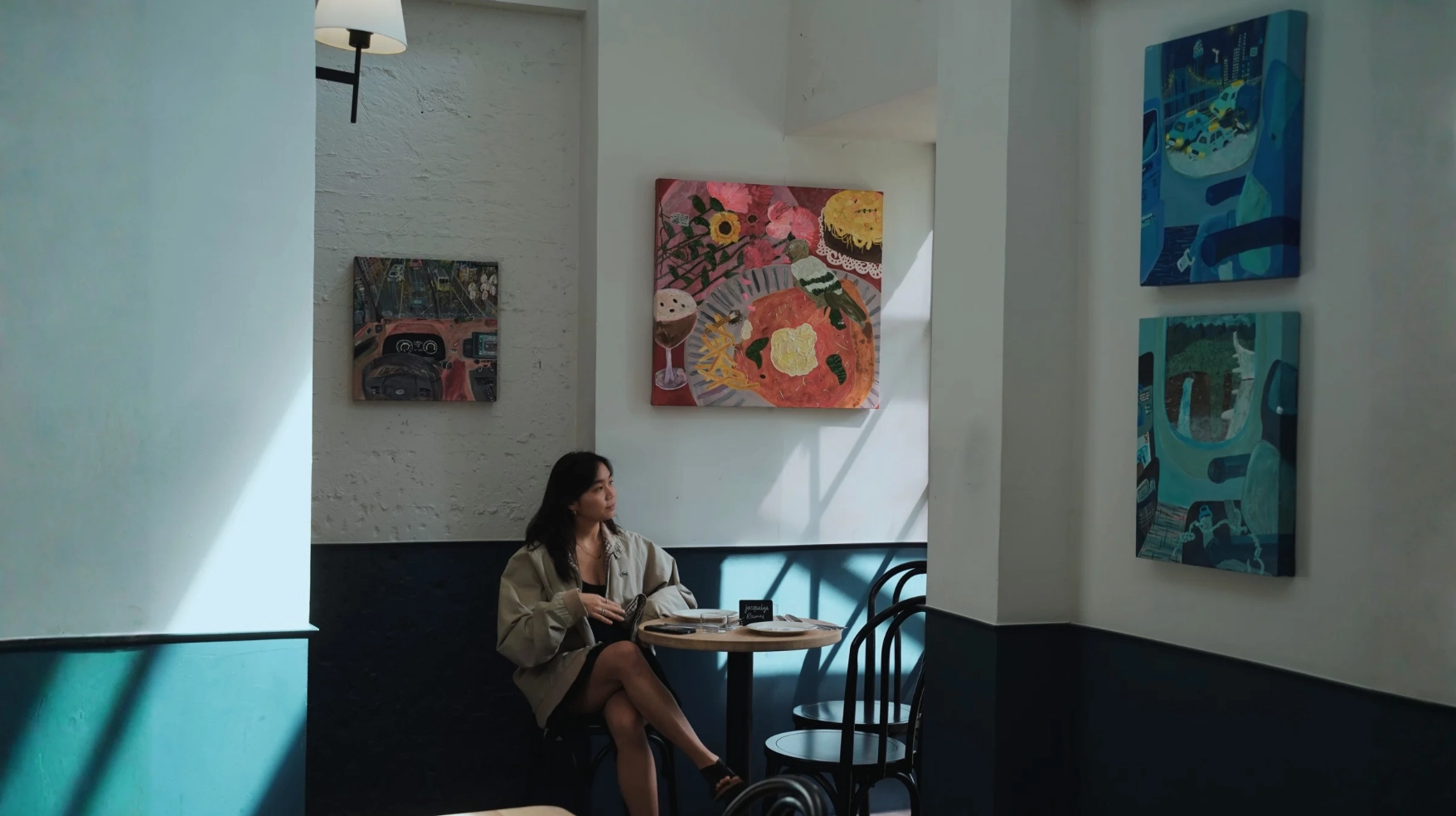
While she’s primarily a painter by practice, like the many artists that have come before her, she stretches her muscles and begins to sow the seeds of ideas through a sketchbook, which she takes with her during excursions. What ensues is a practice of observation and distillation: scenes that move fast, moments slipping away, captured quickly through linework (it takes her roughly an hour to finish a scene), and later filtered through fragments of memory as she renders them on canvas.
The goal of Batungbacal’s works isn’t accuracy or a play-by-play of visual cues. Instead, objects and spaces are made into motifs, transformed by the ways she remembers them—or in the spirit of Berger’s words, chooses to remember them.
In And Out Of The Canvas
The choice of staging from where I sit within the walls of the newly opened June Eatery felt like a fitting experiment with space on the part of curatorCuratorA specialist who selects, researches, and interprets works for museums, galleries, and exhibitions, shaping the story that visitors experience. Curators also care for collections, and their vision determines how artGo to Curator Glossary Ayni Nuyda. She had long been interested in playing with spatial dynamics, finding ways to move beyond the constraints of the conventional gallery, where the connection between viewer and artist tends to feel “dichotomous,” as she puts it. By situating the works within a more communal, casual setting (spanning the restaurant’s lower and upper floors) she hoped to create a more immediate, engaged encounter between audience, artwork, and artist.
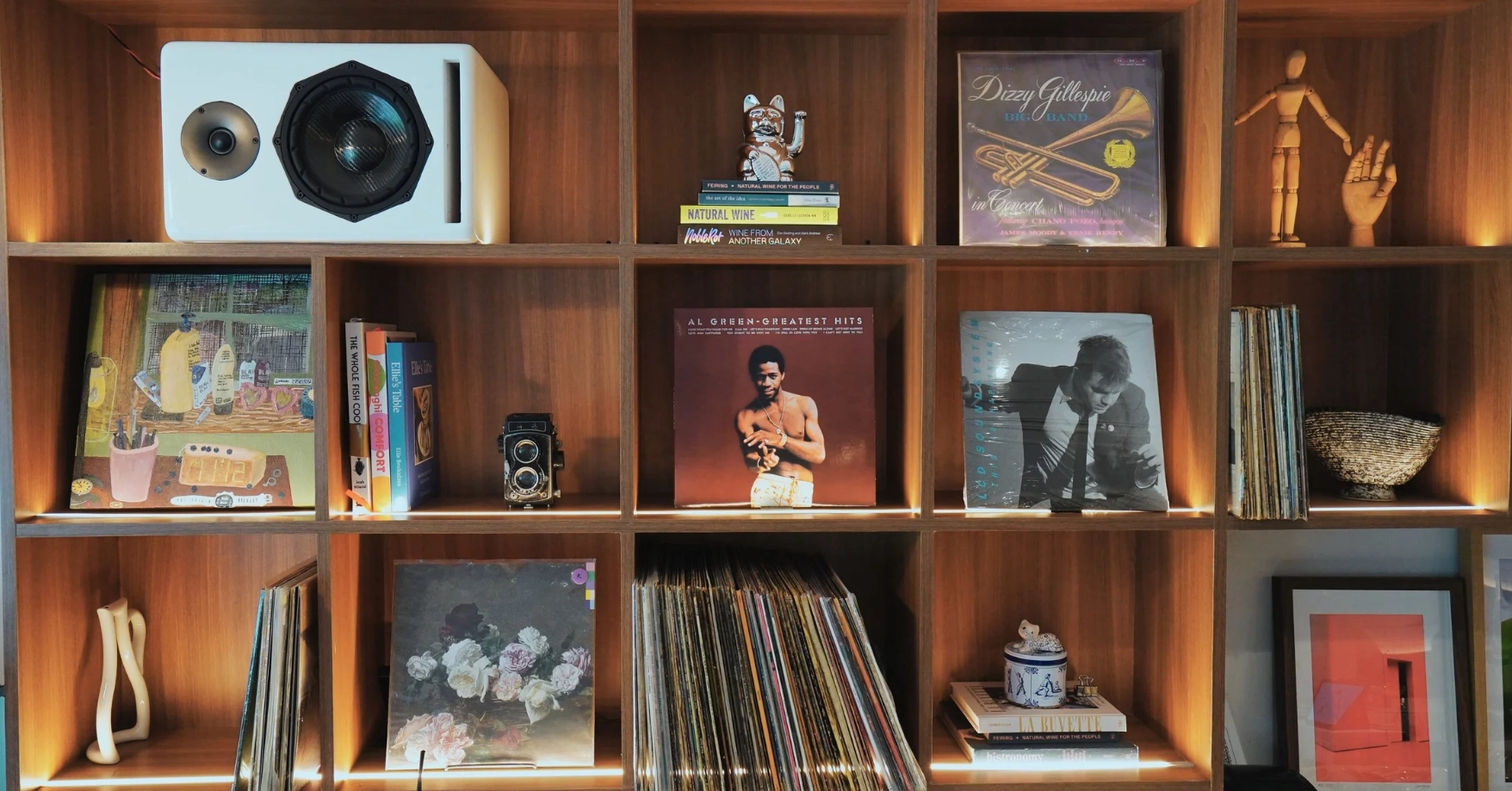
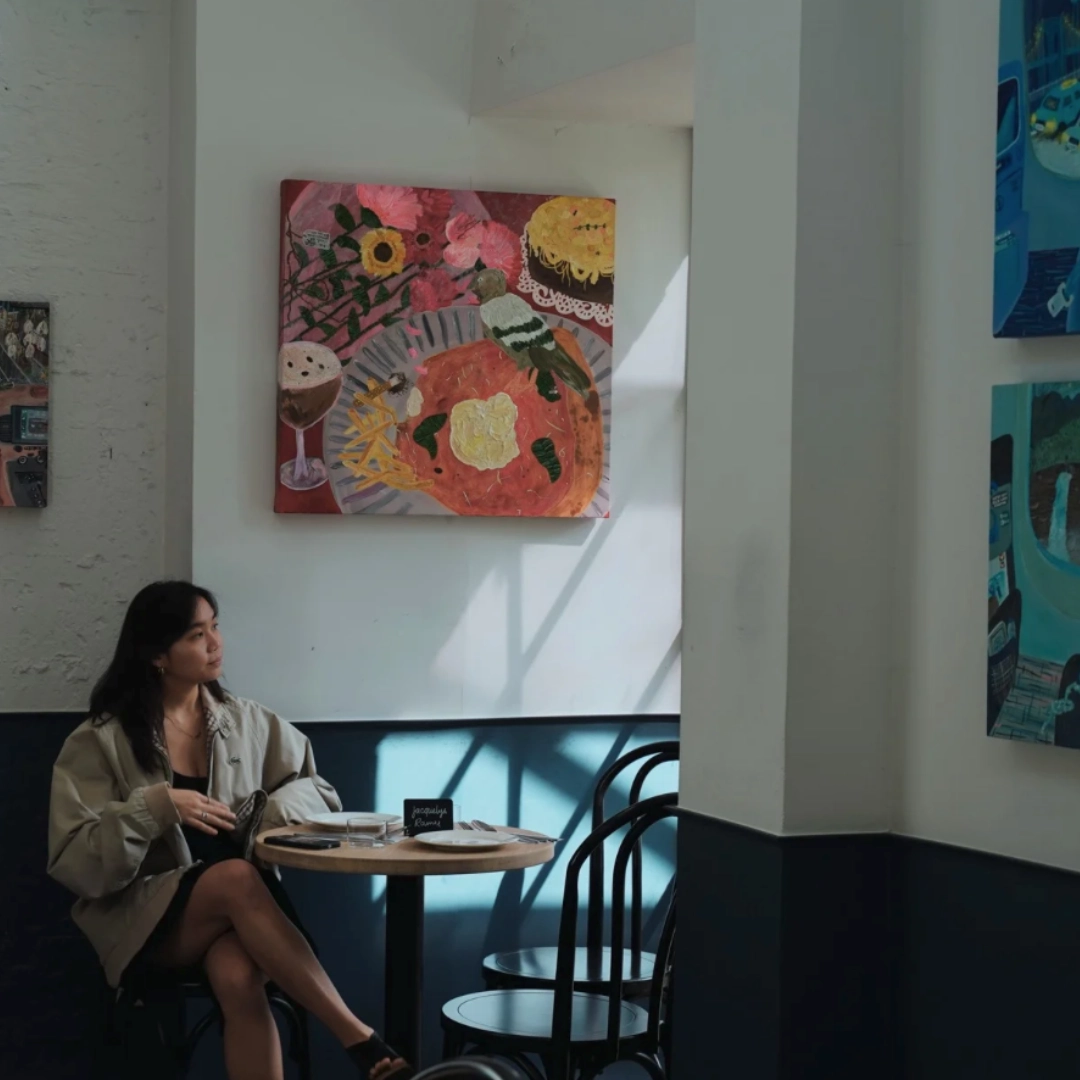
If the opening was any indication, the approach worked. The space encouraged people to stay and engage, not just with the pieces but with one another and the artist herself, over food and drinks. The works revealed themselves gradually, tucked into the rhythms of the space, from the cubbies of vinyl shelves to white walls and wooden tables.
A Closer Look At from where i sit
There’s a paper cut-out or collage-esque quality to Batungbacal’s works, an effect of her textured techniques with acrylic paint. It’s representative of her own approach, where scenes become assemblages of memories. Color also plays an important role: in “The Arrival,” what’s recognizably New York is bathed in an urban blue, cool tones that hum with electric possibility, punctuated by glowing yellow lights. Its sister piece, “The Departure,” contrasts this with earthier tones, a waterfall scene exuding a kind of contemplative warmth.
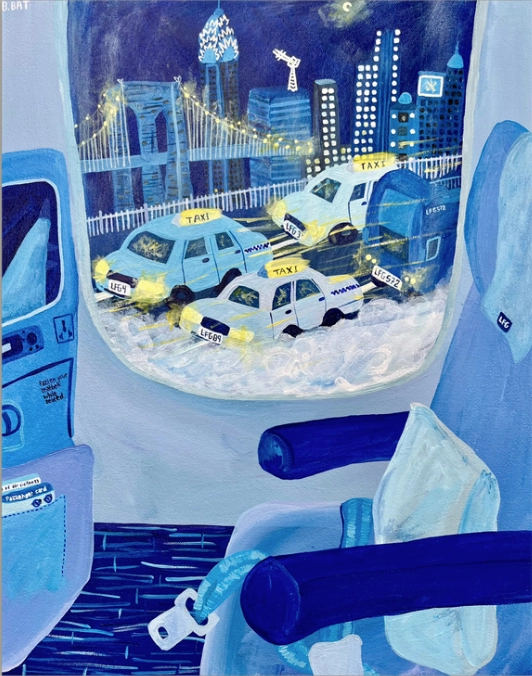
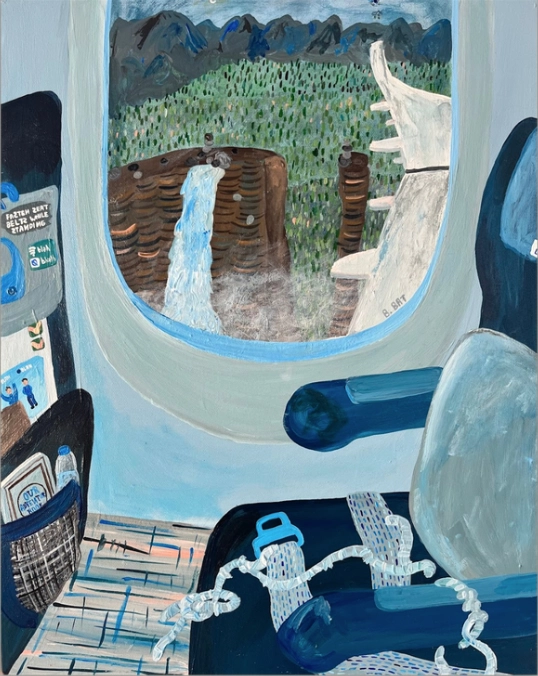
Windows are prevalent, providing an amount of distance and inventive perspective. In these pieces, notice how you, as the viewer—and she, as the artist—don’t view scenes from a first person perspective, but rather, a more omniscient one. “The window shifts from barrier to frame, holding the outside world just far enough away for it to become image, memory, and mood,” writes Nuyda in her curatorial notes.
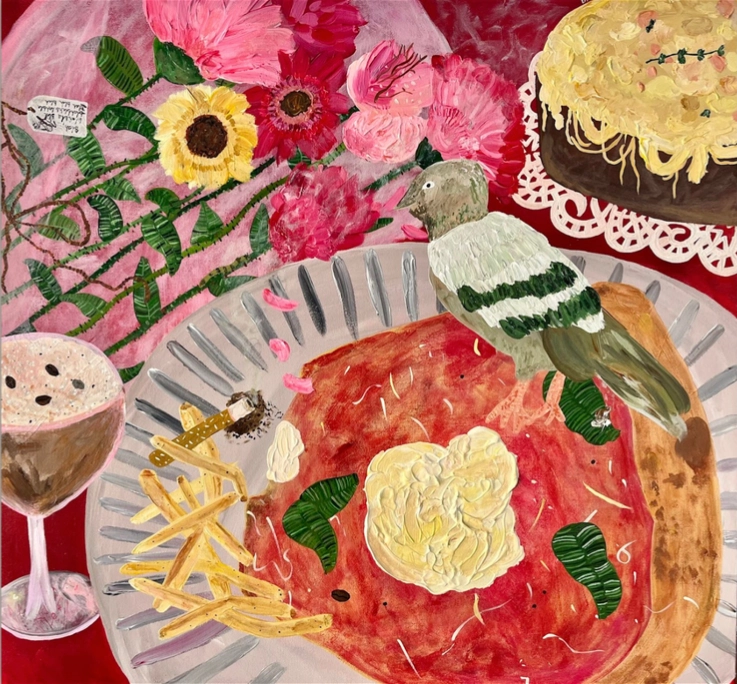
Batungbacal’s awareness of space as a character continues in works like “Misfire,” “Sampaguita,” “Love,” and “The Tornado,” which push perspective back to the viewer. The first two depict mundane scenes, yet even in the seeming everyday, one can see objects laying out a greater narrative. In “Love,” the sweet tokens and gestures of a paramour, food laid out and eaten, flowers strewn in a bouquet, imperfections (including a cigarette caught within a mess of fries and a hungry pigeon) adding to the charm while reminding us of love’s complexities.
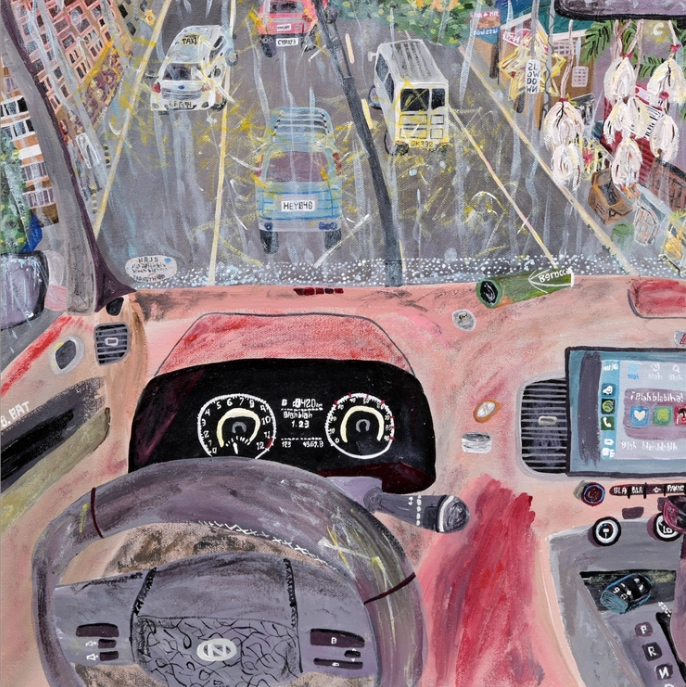
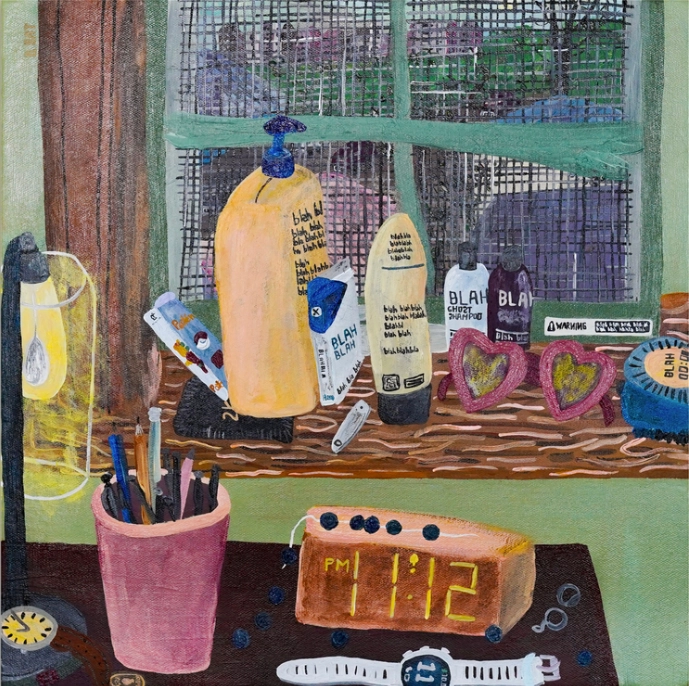
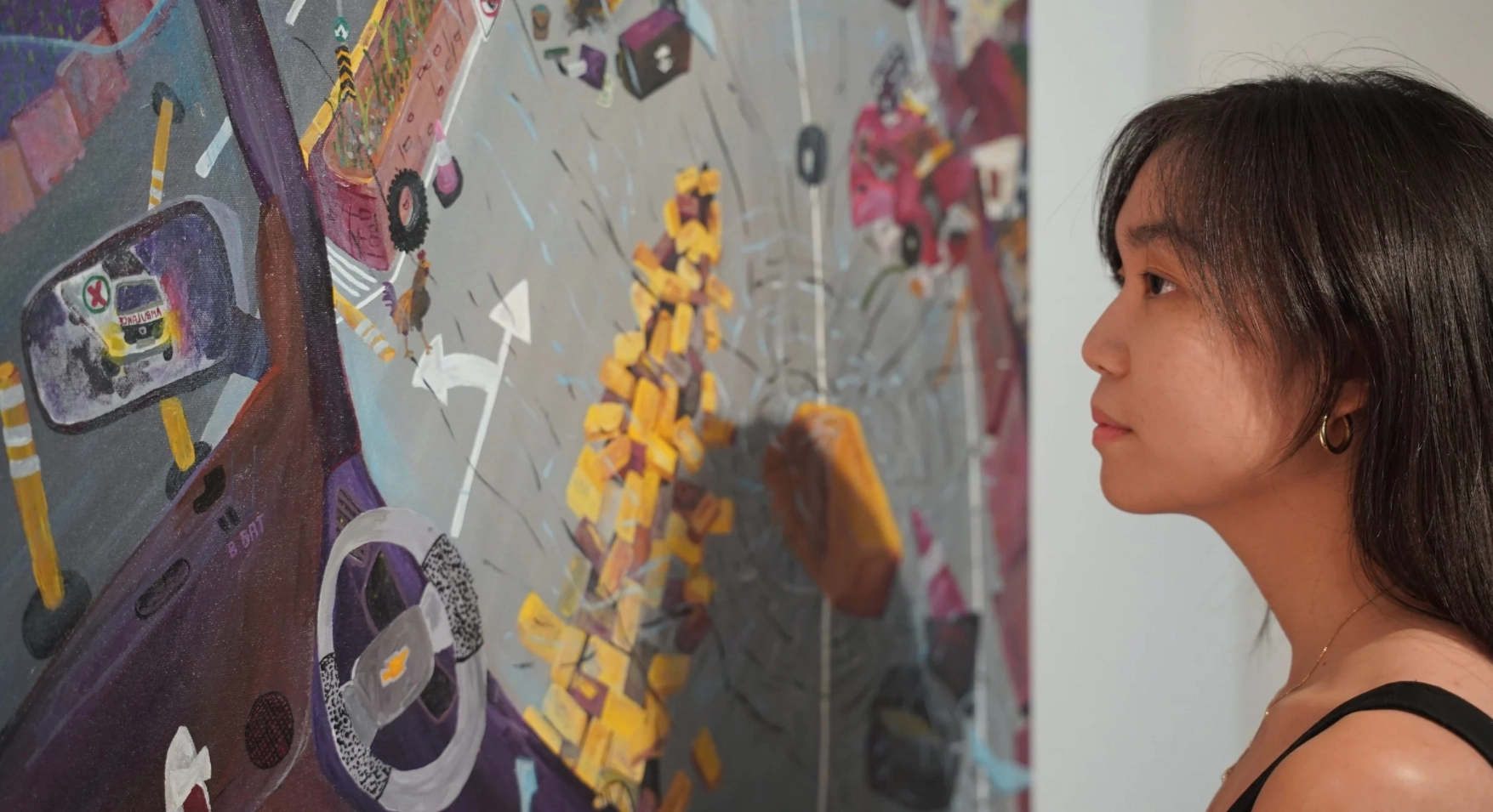
Time passing and the domestic space shine in “Misfire,” while “Sampaguita” depicts a common scene of driving along busy Manila streets, a collection of white flowers symbolic of the poverty that pervades the concrete landscape.
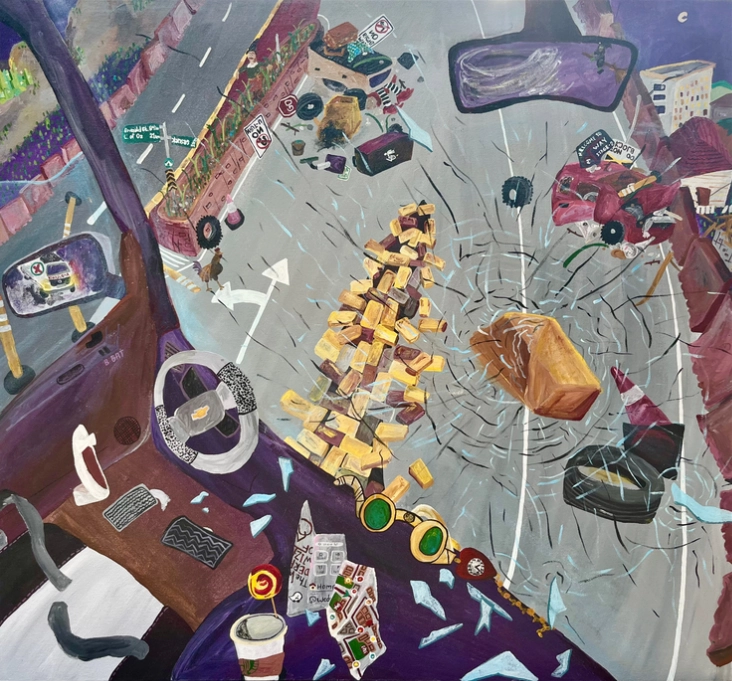
“The Tornado” is perhaps the most fantastical piece in the exhibition, taking viewers inside the titular raging column of air, within a car thrown up and suspended midair (with a broken window as well), watching the city grow smaller from above as objects are scattered. “Inspired by The Wizard of Oz, the work reverses the familiar narrative of escape,” writes Nuyda in her notes. “Instead of being carried somewhere magical, this is the anxiety of disorientation, the yellow brick road fractured, the skyway looming, direction uncertain.
Batungbacal’s black and white sketches, also presented in from where i sit, reflect these sensibilities, though they peel back the finality of her paintings, adding a layer of increased vulnerability. These are moments in their rawest form, the purest product of an artist’s gaze, artifacts of the ephemeral. They’re not necessarily “true” in representation, but truthful to an artist’s perception of reality.
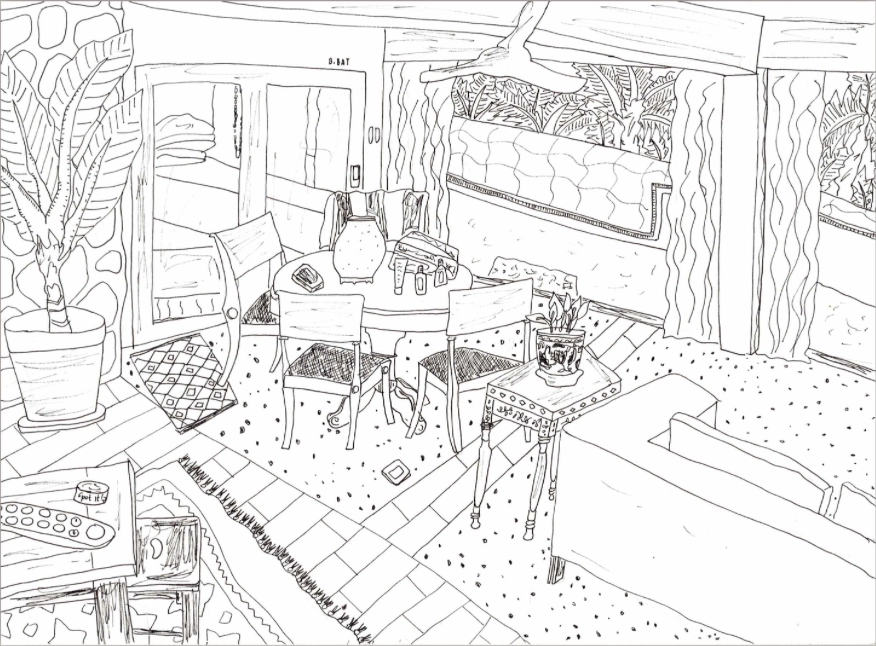
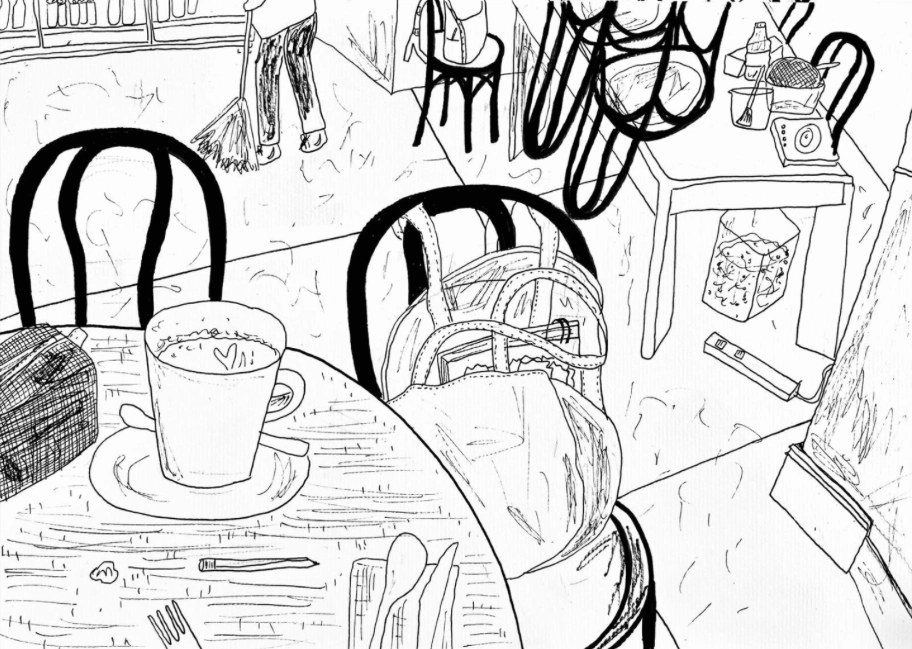
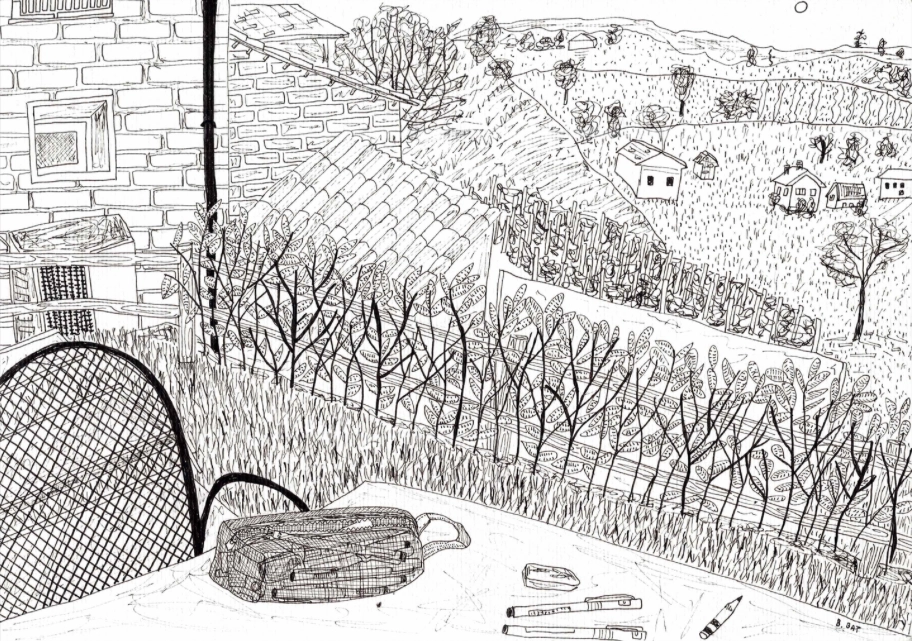
To return to Berger’s words quoted at the beginning of this feature, Batungbacal’s exhibition affirms that we’re never looking at just one moment, but at the roles its elements play within the larger picture of our own lives. Time may pass and places may change, but what endures is a way of seeing, one where memory is made indelible through the things that matter to us.
Catch “from where i sit” at June Eatery. For acquisition inquiries, you may contact Ayni Nuyda at +63 917 112 1619 or [email protected].
Artworks courtesy of Bea Batungbacal
Photography by Ayni Nuyda
Frequently Asked Questions
Bea Batungbacal’s exhibition explores the relationship between objective reality, spatial dynamics, and subjective memory. Curated by Ayni Nuyda, the collection features texturized acrylic paintings and raw black-and-white sketches that distill fleeting everyday moments and international travel observations into permanent visual motifs.
The exhibition is hosted at June Eatery, an alternative culinary venue. By staging the artwork across the restaurant’s upper and lower floors rather than within a traditional gallery setting, the curation subverts conventional viewer-artist boundaries to foster organic community engagement.
Batungbacal utilizes a heavy texturing technique with acrylic paint that gives her canvases a paper cut-out or collage-like quality. Her process begins with immediate, hour-long pen sketches inside a travel journal, which are later translated onto canvas through a selective distillation of color and perspective.
In pieces like Sampaguita (2025), Batungbacal captures common scenes from busy Manila streets. The work utilizes a collection of local white flowers to subtly communicate narratives of socioeconomic reality and poverty, embedding profound social commentary within the framework of domestic, everyday streetscapes.
For acquisition inquiries and private catalog viewings of Bea Batungbacal’s artwork, collectors can contact curator Ayni Nuyda directly via email at [email protected] or through her institutional curatorial channel to review the remaining available portfolio.